💡 AI Blogging · Content Strategy · Idea Generation
AI Tools for Blog Post Ideas
(When You've Run Dry)
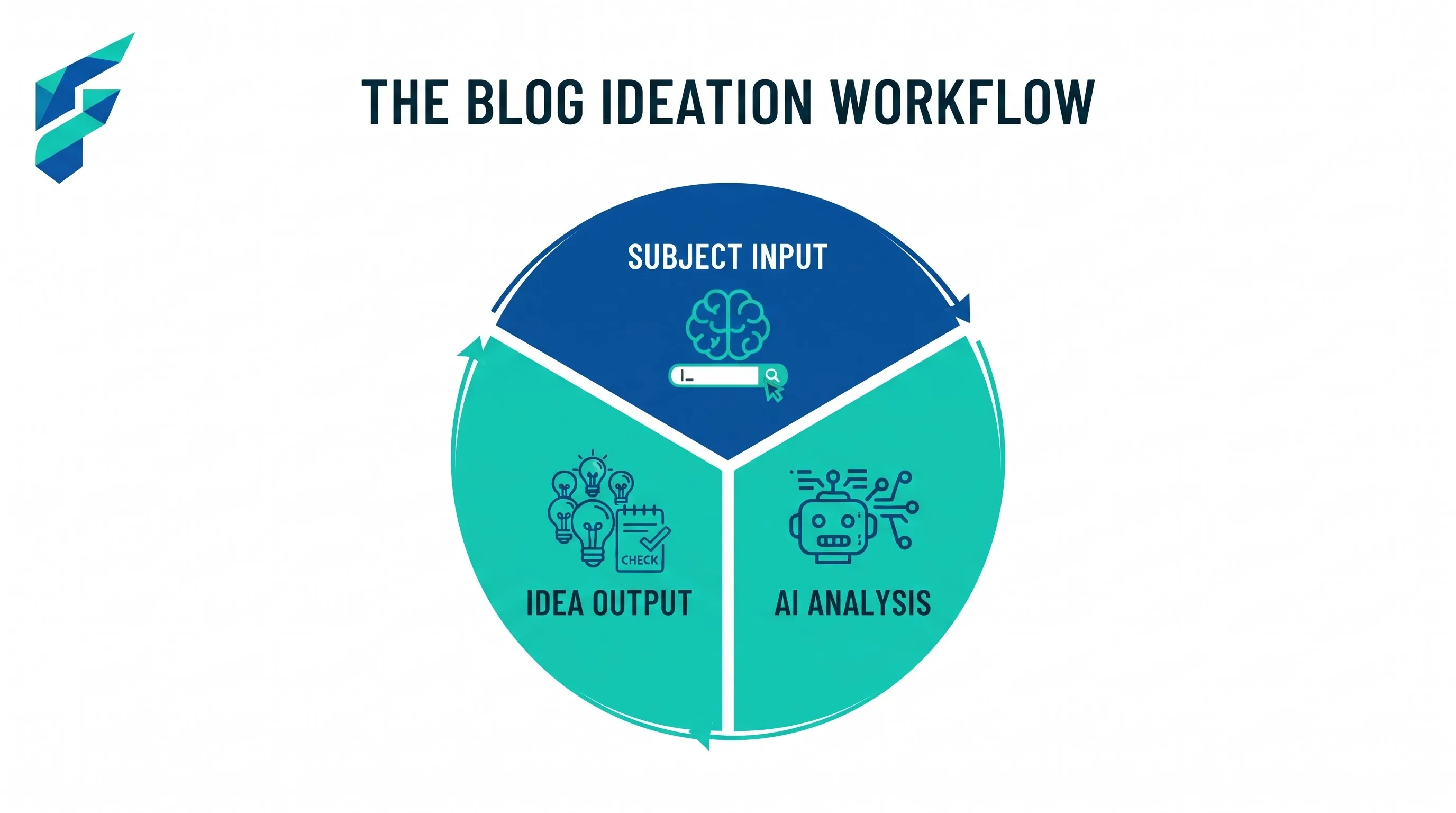
Every blogger hits the same wall eventually: you've covered the obvious topics, the calendar says you need something published this week, and staring at a blank "new post" screen isn't producing anything. This is exactly the situation AI is good for — not writing the post, but breaking the specific kind of block where you can't even land on what to write about.
Why the obvious prompt doesn't work
Typing "give me blog post ideas about [your industry]" into a chatbot gets you a list any business in your industry could have gotten. It's not wrong, it's just generic — the same five or six ideas that show up whenever anyone asks that exact question. If you've tried this and felt underwhelmed by the results, that's why.
What actually produces better ideas
Feed it something more specific than your industry. Your actual customer questions — pull five real ones from support tickets, sales calls, or DMs — and ask the AI to find the angle nobody else covering your topic has taken. Or point it at a competitor's blog and ask what they haven't written about yet, which tends to surface real gaps instead of generic suggestions.
This connects to a bigger point about AI content strategy — the idea-generation step is strategy, even though it feels like the easy part before the "real" writing starts.
For example, a reader once asked us how to justify the cost of an AI tool to a non-technical founder. Instead of generating a generic "AI benefits" post, we fed that exact phrasing into our workflow. The result was a highly specific guide on calculating AI ROI for small business owners, which became one of our top-performing and most-linked articles.
A few prompts that actually produce something useful
- "Here are five questions my customers ask most often: [list them]. What blog post angles would actually answer these in a way that's more specific than what's already ranking for these topics?"
- "Here's a link to [competitor's blog]. Based on what they've covered, what's an angle in this space they haven't written about?"
- "I sell [specific thing] to [specific audience]. What's a contrarian or unexpected angle on [broad topic] that most content in this space avoids?"
Notice none of these ask for ideas in the abstract — they all hand the AI something specific to work from.
Where this connects to actually ranking
Having a good idea is only step one. If you want that idea to actually rank, not just exist, ranking a blog post with AI picks up from here — covering the research and structure side of turning an idea into something that performs.
The "Content Gap" Audit Workflow
Beyond just asking for new ideas, AI excels at auditing what you already have. You can paste the titles and URLs of your last 20 blog posts into a chatbot and ask: "Identify three logical follow-up topics or deeper dives that we haven't covered yet." This prevents you from accidentally writing a post that cannibalizes your own existing traffic, ensuring every new idea genuinely expands your topical authority rather than just repeating yourself.
Leveraging Search Intent Over Keywords
A common mistake is generating ideas based purely on keyword volume, ignoring what the user actually wants. A better prompt is: "Here is a list of low-competition keywords in my niche. For each, tell me the primary search intent (informational, transactional, navigational) and suggest a blog post title that perfectly satisfies that specific intent." This forces the AI to think like a searcher, not just a keyword stuffer, resulting in ideas that are much more likely to earn clicks and engagement.
The ideas worth skipping
Anything a competitor has already covered thoroughly and well, unless you have a genuinely different angle or more specific expertise to bring. Publishing a weaker version of something that already exists rarely ranks and rarely gets read — better to find the gap than to compete head-on with something already established.
I once generated an idea for "The Ultimate Guide to AI Marketing" but scrapped it immediately. The SERP was already saturated with massive, well-funded guides from major SaaS companies. Instead, I pivoted to "3 AI Marketing Automations You Can Build in 10 Minutes," which targeted a specific, underserved long-tail intent and actually drove conversions.
A realistic idea-generation routine
Once a month, pull your team's most-asked customer questions, feed them to an AI tool alongside a note on what you've already published, and ask for gaps rather than a fresh list from scratch. This produces fewer ideas than a generic brainstorm, but a higher share of them are actually worth writing.
For more on turning a steady stream of ideas into an actual regular publishing habit without burning hours on it, our guide on AI blogging tools covers the rest of the process end to end.