✍️ AI Content Marketing · Blogging · SEO
Best AI Tools for Blogging
(The Full Toolkit, Not Just a Writer)
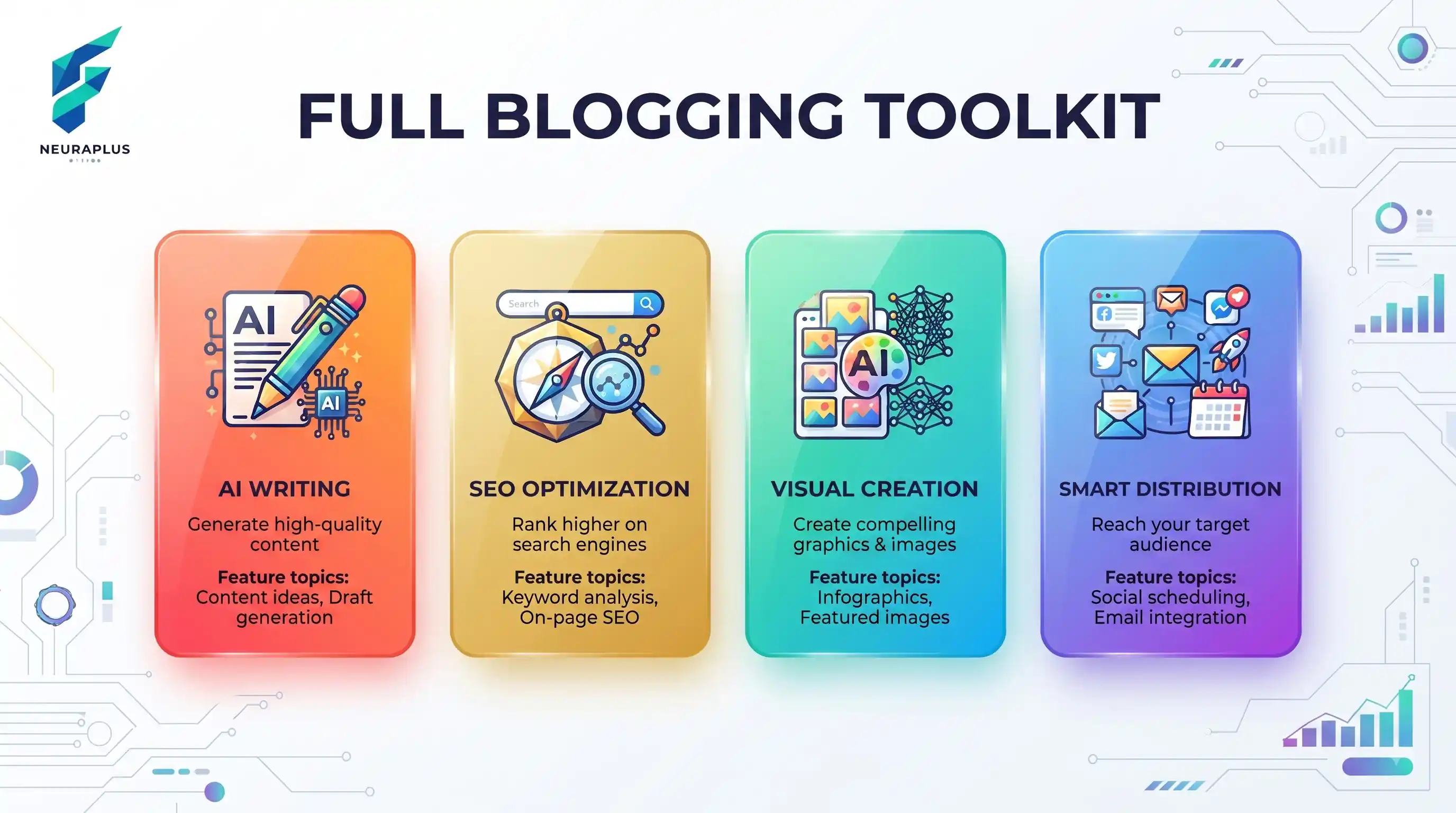
Most "best AI blogging tools" content focuses entirely on the writing step, as if that's the whole job. It's not. A blog post that actually performs needs an idea worth writing about, writing that doesn't sound like a template, an image that fits, and a structure that gives it a real shot at ranking. Here's the full set, not just the drafting piece.
Step 1: Finding an idea worth writing about
Before anything else, you need a topic with a genuine angle — not just a generic keyword everyone else is also writing about. Our guide to AI tools for blog post ideas covers how to get past the generic topic-list problem and find something actually worth your time to write.
Step 2: Writing it
A general AI chatbot (ChatGPT, Claude) is genuinely good at drafting, provided you feed it real specifics instead of a vague prompt — covered in detail in our guide to AI writing tools for small business, including the difference between a flat, generic AI draft and one that actually sounds worth reading.
My current process involves feeding Claude a highly detailed outline with my specific tool-testing data and raw thoughts. It generates a solid structural draft in minutes, but it still requires about 2 hours of heavy human editing to inject our unique voice, verify the technical claims, and ruthlessly cut the standard "AI fluff" that plagues automated content.
Step 3: Making sure it can actually rank
Having a well-written post isn't the same as having one that ranks. Structure, keyword targeting, and matching what a search actually wants to see matter as much as the writing quality itself — this is a distinct skill from drafting, covered in our guide to ranking a blog post with AI tools.
Step 4: Visuals
A post with no image, or a generic stock photo, underperforms one with a considered header image and relevant supporting visuals. For the broader category of AI image generation beyond just blog use, our guide to AI tools for image generation covers where this works well and where it doesn't.
Step 5: Turning one post into more reach
The highest-ROI step most small businesses skip: pulling a strong stat, a practical tip, and a discussion-worthy question out of a finished post to repurpose as social content, instead of letting the post's reach stop at whoever happened to find it directly.
Our deep-dive post on "AI Thumbnail Design" got moderate, steady traffic from SEO. But when we pulled 3 key contrarian tips from the article into a Twitter thread and a LinkedIn carousel, the social reach drove 4x more visitors back to the site in one week than the original search ranking did in a month. Repurposing is where the real leverage lives.
The AI Blogging Pipeline: Tools & Time Investment
| Pipeline Step | Best AI Tool Type | Time Saved | Human Effort Required |
|---|---|---|---|
| 1. Ideation | AI Brainstorming / Trend Analysis | High | Selecting the unique, defensible angle |
| 2. Drafting | LLMs (Claude, ChatGPT) | Medium | Heavy editing, fact-checking, voice injection |
| 3. SEO Structuring | AI SEO Assistants (Surfer, Frase) | High | Final keyword placement & intent matching |
| 4. Visuals | AI Image Generators (Firefly, Midjourney) | High | Prompting & ensuring brand consistency |
| 5. Repurposing | AI Social Snippet Generators | Very High | Formatting for specific platforms & engagement |
Putting the whole pipeline together
Each of these steps has its own dedicated tools and considerations, but they work best as a connected process rather than five disconnected tasks. If you're setting this up from scratch, our complete guide to building a content pipeline with free AI tools walks through the whole sequence end to end, with specific free tools for each step.
How often this whole pipeline is actually worth running
Not every business needs to publish weekly, and trying to force a publishing cadence you can't sustain tends to produce weaker posts than a slower, more consistent pace. A realistic rule of thumb: publish as often as you can maintain real quality at every step of this pipeline — idea, draft, ranking structure, visuals, repurposing — without skipping steps to hit a deadline. One genuinely good post every two weeks, fully executed, tends to outperform four rushed ones in both reader response and search performance over time.
At Flexora.Ai, we've settled on one deeply researched, fully formatted post every 10 days. Early on, trying to push for twice a week resulted in shallow "listicles" that barely ranked and burned me out. Slowing down allowed us to actually test the tools we write about, resulting in content that converts readers into newsletter subscribers.
The realistic expectation
AI tools remove a lot of the friction at every step of this pipeline — the blank page, the tedious resizing, the manual repurposing. They don't remove the need for a genuine angle, real editing, or a human decision about what's actually worth publishing. The businesses getting real value from AI-assisted blogging are the ones treating it as a faster version of a real process, not a replacement for having one.
My current routine involves spending Monday on ideation and outlining, Tuesday on AI-assisted drafting and heavy human editing, Wednesday on SEO structuring and image generation, and Thursday on repurposing. AI hasn't replaced my brain; it's just removed the 4 hours of staring at a blank screen and manually resizing images for Pinterest. The strategy is still 100% human.