🌍 AI Translation · Small Business Tools · Localization
Best AI Translation Tools for Small Business
(Compared)
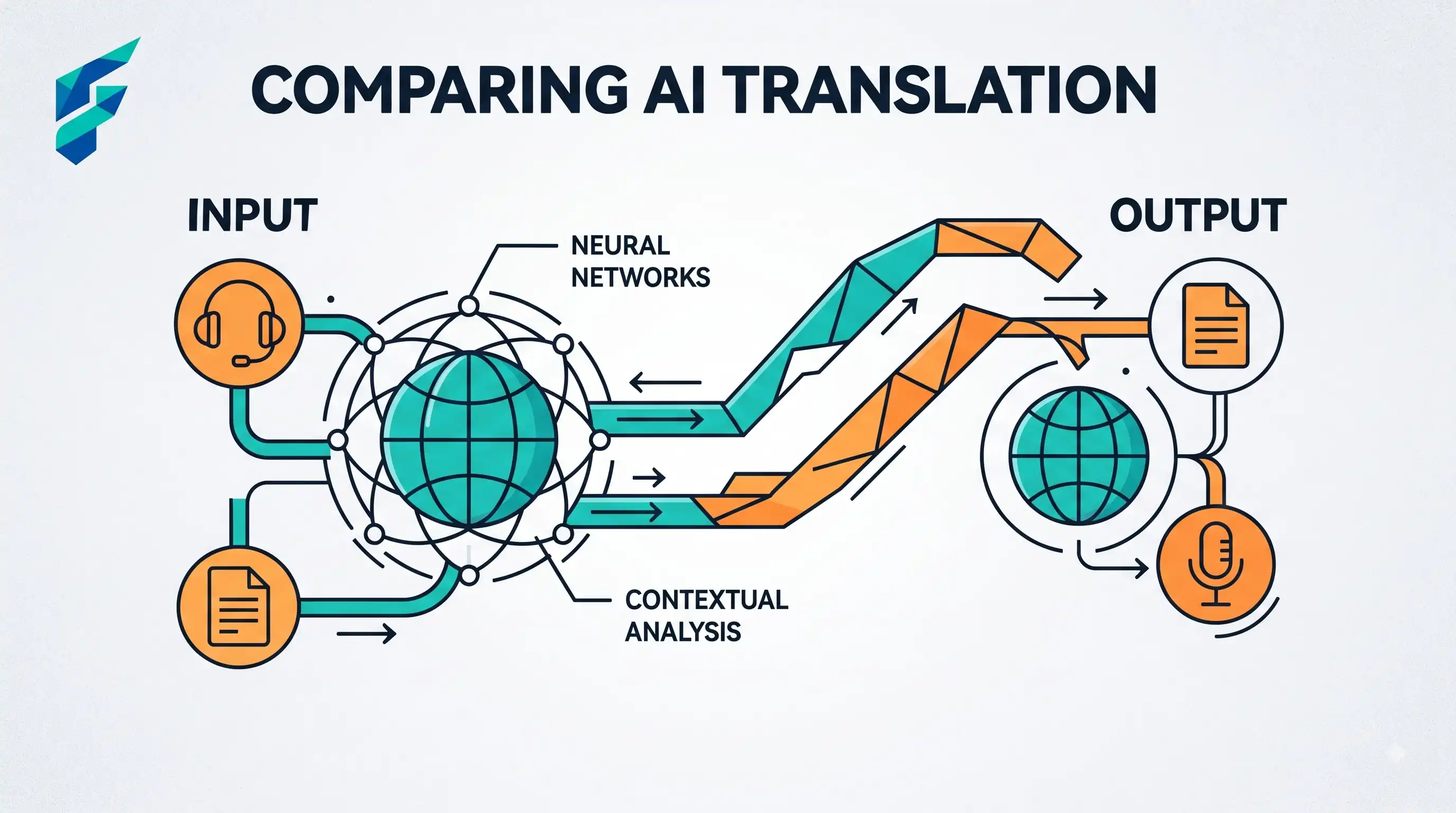
Translation isn't one category of tool — it splits into document translation, website translation, live conversation, and video, and the strongest tool often differs by category. Picking "the best" translation tool overall is less useful than picking the right tool for your specific need.
For documents and written content
This is where translation tools are most mature and most reliable. DeepL has a strong reputation specifically for document and long-form text translation, generally producing more natural-reading output than more general-purpose translation tools, particularly for European language pairs. It's worth trying on a real sample of your own content before committing, since quality does vary by language pair.
We regularly test English to Spanish, French, and German for our client documentation. DeepL consistently captures the nuance of formal business phrasing far better than generic alternatives, avoiding the robotic, literal translations that can undermine professional credibility.
For websites
Auto-translation widgets handle the "make my site accessible in other languages" need with minimal setup, though with real limitations on quality and SEO — covered in more depth in our guide to free AI translation tools for websites, including where the free tier genuinely falls short and when it's worth paying for something more robust.
For live conversations
A fundamentally different, harder problem than translating static text — accuracy drops with background noise, overlapping speech, and fast-paced conversation. Our dedicated guide to real-time translation tools covers where this is reliable enough to lean on and where it still needs a backup plan.
For video content
Subtitle translation and AI dubbing are different problems with different reliability levels — subtitles are considerably more mature and lower-risk than generated dubbed audio. Worth reading on its own given how different the two approaches are within the same broad category.
AI Translation Tools: A Use-Case Comparison
| Use Case | Tool Maturity | Best Tool Type | Key Limitation |
|---|---|---|---|
| Documents & Text | Very High | Dedicated engines (e.g., DeepL) | Requires manual glossary setup for jargon |
| Websites | High | JavaScript widgets / CMS plugins | Poor SEO indexing; quality varies |
| Live Conversation | Medium | Real-time audio transcription apps | Struggles with background noise/overlap |
| Video Content | Medium-High (Subtitles) Low-Medium (Dubbing) |
Subtitle generators / AI voice cloners | Dubbing often lacks natural emotional tone |
What actually separates good tools from mediocre ones
- Handling of specialized terminology. General-purpose translation tools often stumble on industry-specific terms. If your content is technical, legal, or uses a lot of specific jargon, look specifically for a tool that lets you build a custom glossary of terms that should always translate a certain way.
- Context awareness. The better tools increasingly translate full sentences and paragraphs with attention to surrounding context, rather than translating word-by-word or sentence-by-sentence in isolation — this matters a lot for anything where meaning depends on what came before it in the text.
For example, generic translation tools frequently mistranslate SaaS-specific terms like "churn rate" or "API rate limits" into literal, nonsensical phrases in other languages. A tool that allows you to define and lock a custom glossary fixes this immediately.
How pricing actually breaks down
Most AI translation tools follow a similar pattern: a free tier covering a limited character or word count per month, then paid tiers scaling with volume. DeepL's paid tiers unlock larger document translation limits and API access for connecting translation directly into other tools you use.
Website translation widgets often price by page views rather than word count, which matters if your site gets meaningful traffic — a free tier that works fine for a low-traffic site can hit its limit fast once you're actually getting visitors in multiple languages. We initially used a free website translation widget, but once our international traffic grew past 1,000 views/month, we hit the limit and had to upgrade to a paid tier to maintain accessibility.
Where human review is still worth it
Regardless of which tool you use, anything with real legal, financial, or reputational weight — contracts, formal agreements, public-facing marketing in a language your team can't personally verify — deserves a human review pass before it goes out. Treat AI translation as a strong first draft for high-stakes content, not the final word.
A realistic starting point
For most small businesses, DeepL for documents, a website translation widget for general site accessibility, and a native-speaker review for anything that actually matters covers the bulk of real translation needs without a large budget.
Our current stack relies on DeepL Pro for all internal and client-facing documents, a lightweight widget for general website browsing, and a dedicated freelance reviewer for our official marketing landing pages in Spanish and French. This hybrid approach keeps costs predictable while ensuring quality where it counts.
External resources
- DeepL — a strong general starting point for document translation, with a usable free tier.