🌍 AI Translation · Real-Time Communication · Customer Support
AI Tools for Real-Time Translation
(Live Calls and In-Person Conversations)
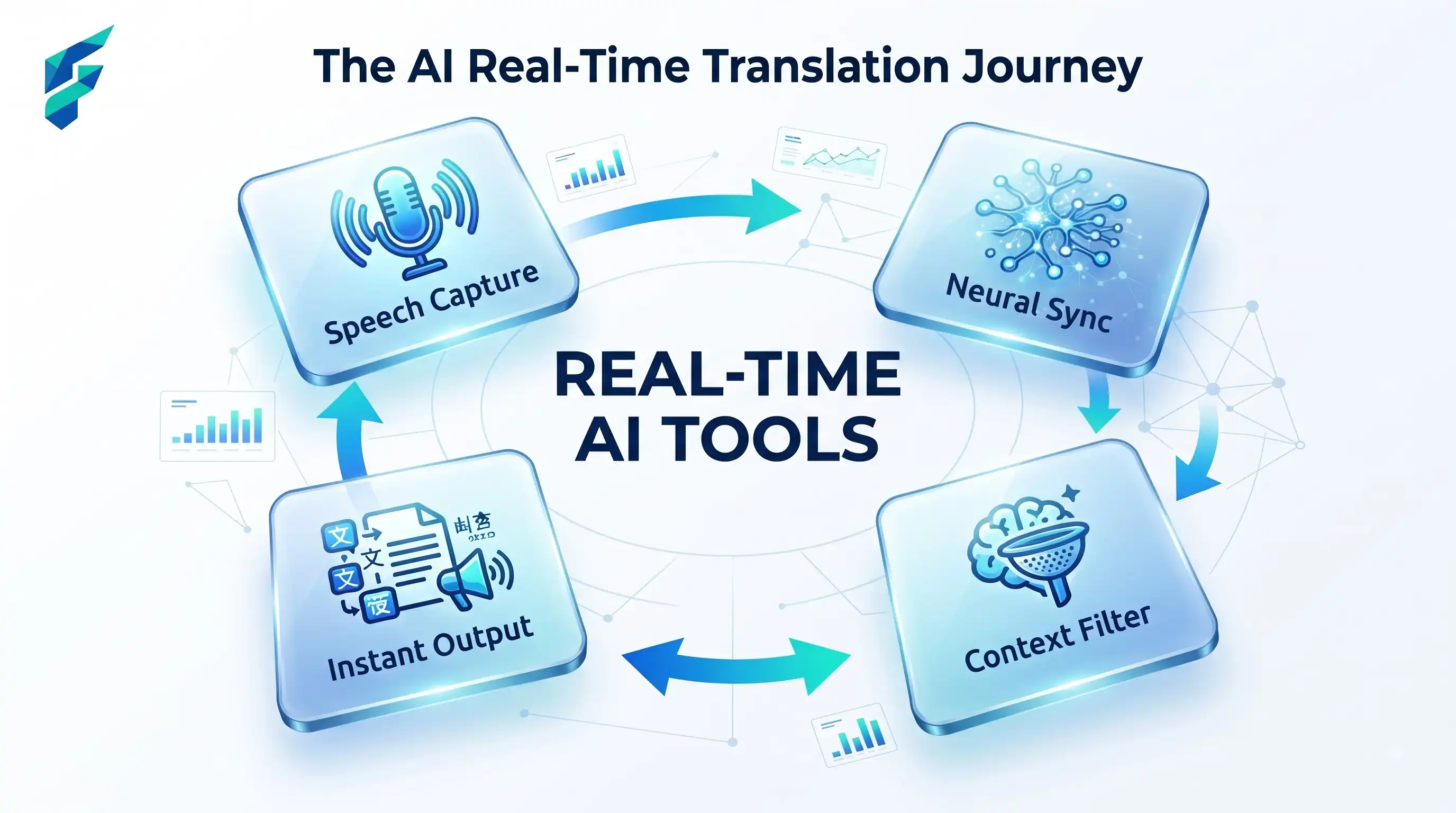
Real-time translation is a different, harder problem than translating a static document. There's no time to review the output before it's spoken or displayed, which means any error happens live, in front of the person you're talking to. That raises the stakes compared to document translation, even though the underlying technology is related.
Where it works well enough to rely on
- Simple, transactional conversations. Confirming an order, answering a basic question, handling a straightforward customer service interaction — real-time AI translation handles this reasonably well, and a small lag or slightly awkward phrasing rarely derails a simple exchange.
- Live captions during calls. Real-time captioning with translated text, used in video calls, tends to be more reliable than spoken AI translation, since the viewer can see the words rather than relying on synthesized speech timing and intonation to land correctly.
For example, we recently used a real-time translation tool during a support call with a Spanish-speaking client to confirm a software license renewal. The transaction was straightforward, the AI captured the key details (dates, pricing) accurately, and the slight robotic cadence didn't hinder the successful outcome.
Where it gets shakier
- Fast, overlapping, or emotionally charged conversations. Real-time translation struggles most exactly where accuracy matters most — a tense customer complaint, a negotiation, anything where tone and nuance carry real weight. Lag and mistranslation compound the existing difficulty of an already hard conversation.
- Background noise and multiple speakers. In-person settings — a busy retail floor, a loud environment — degrade accuracy noticeably compared to a clean, single-speaker audio feed. If you're relying on this for in-person customer interactions, test it in your actual environment, not a quiet demo.
Real-Time Translation Use Cases: AI vs. Human
| Scenario | AI Real-Time Translation | Professional Human Interpreter | Recommended Approach |
|---|---|---|---|
| Retail Customer Inquiry (e.g., "Where is the fitting room?") |
Excellent | Overkill | AI Tool (Fast, cost-effective) |
| Video Call Live Captions (e.g., Internal team sync) |
Very Good | Expensive | AI Tool (Reliable for context) |
| Complex Contract Negotiation (e.g., Legal terms, liability) |
Poor (High Risk) | Excellent | Human Interpreter (Required for accuracy) |
| Emotional Customer Complaint (e.g., Refund dispute) |
Poor (Misses nuance) | Excellent | Human Interpreter (Required for empathy) |
Where this fits for customer support specifically
If your business serves customers who don't share a language with your team, this connects directly to how you handle support more broadly — our guide to AI customer support tools covers the wider support toolkit, with real-time translation as one piece of making that support actually accessible across languages.
For translation needs outside live conversation — documents, formal written content — our full comparison of AI translation tools covers that separate, generally more reliable category.
I once attempted to use a live translation app during a noisy trade show to explain a complex technical specification to a potential partner. The background chatter caused the tool to hallucinate words, and the resulting translation was completely nonsensical. We had to fall back on pen and paper to draw a simple diagram, which worked instantly.
A quick way to test a tool before you rely on it
Before trusting any real-time translation tool for an actual customer interaction, run it through a dry test first: have a bilingual team member or friend try a real-sounding exchange and tell you honestly where it broke down — a mistranslated phrase, an awkward pause, a moment it clearly misunderstood tone. Most businesses skip this step and find out a tool's weak points live, in front of a customer, which is the worst time to discover them. Fifteen minutes of testing against a realistic scenario tells you more than any feature list or marketing demo.
When we tested a popular real-time translation tool internally, we found it consistently struggled with industry-specific acronyms, translating them as common words. This 15-minute dry run saved us from looking unprofessional in front of actual clients.
A sensible way to use this
Lean on real-time translation for routine, low-stakes interactions, and have a backup plan — a bilingual team member, a written translation tool, anything — for conversations that are complex, emotionally charged, or genuinely important to get exactly right. Treating it as a universal solution for every language gap, rather than a tool suited to specific situations, is where businesses run into trouble with this category.
External resources
- Google Translate — includes a real-time conversation mode that's a reasonable starting point for simple, low-stakes exchanges, with no cost to try it.