🧬 Google Easter Eggs · Hidden Games
Google Conway Game of Life
Trick
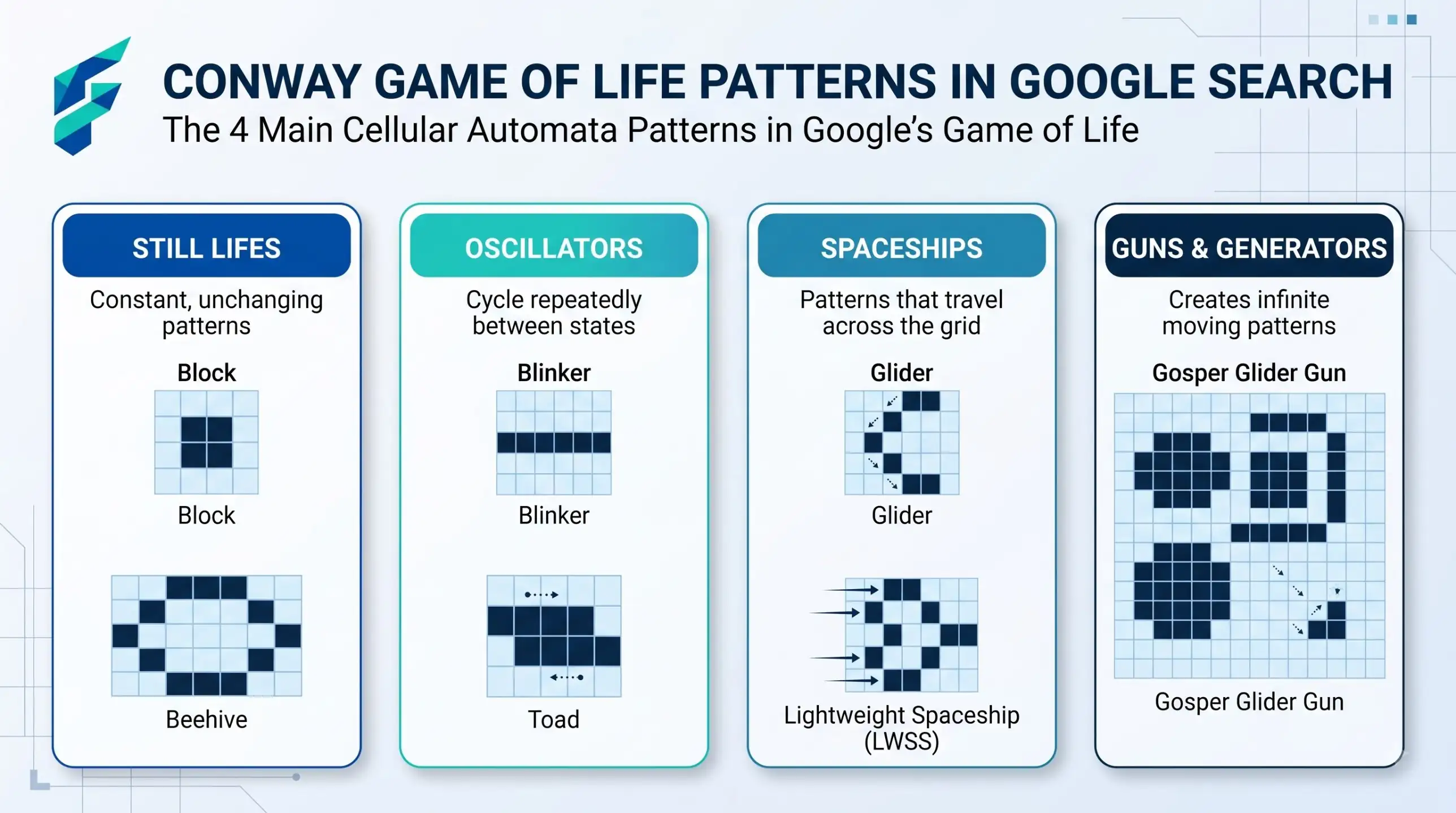
Most entries on our hidden Google games list want you to click, jump or dodge something. This one asks for nothing. Search for Conway's Game of Life on Google and a field of small cells starts to move, die off and multiply by itself, following a few simple rules. Here is how to trigger it, what you are actually watching, and what to do if it does not appear.
Quick answer: Search for conway's game of life in a desktop browser. Small cells appear on the results page and evolve on their own. It is watch-only: you cannot place or move cells.
How to trigger the Game of Life on Google
- Open Google on a desktop browser. A bigger screen gives the cells more room to spread.
- Type the phrase. Search for conway's game of life, with or without the apostrophe.
- Press Enter and watch. Small blue-grey boxes should start moving and spreading across the results page.
- Reload to watch it again. Refreshing the results page is the simplest way to restart the show.
If you only see normal results: check the spelling, try another browser and clear your cache. Google changes or removes Easter eggs without announcement, so a missing animation does not always mean something is wrong on your side.
What you are actually watching
The Game of Life is a "zero-player" game designed in 1970 by the English mathematician John Horton Conway. Nobody plays it. You set a starting pattern, and a few rules decide everything after that. Each square is either alive or dead, and on every step the rules look at how many live neighbours it has.
| Situation | What happens next |
|---|---|
| Live cell with 2 or 3 live neighbours | Survives |
| Live cell with fewer than 2 or more than 3 | Dies |
| Dead cell with exactly 3 live neighbours | Comes alive |
From those three rules come shapes with names: blocks and beehives that never change, blinkers that flip back and forth, and gliders that crawl diagonally across the grid. Google's version is one of the quieter entries in our complete list of Google Easter eggs, because all you can do is watch.
Where the trick came from
Search Engine Roundtable reported it on 12 July 2012 as Google's latest Easter egg, and other search sites picked it up soon after. Googler John Mueller mentioned it on Google+, recalling that he had built a version as a kid, hunting for patterns that sustain themselves and gliders that cross the field. It fits Google's habit of hiding references that programmers and mathematicians will recognise.
Tips for getting more out of it
- Look for shapes that freeze. Patterns that stop changing after a few steps are called still lifes.
- Look for travellers. Small groups that move steadily in one diagonal direction are gliders.
- Give it space. Use a large desktop window so the cells have room to spread.
- Try another nerdy search. The Google answer to life trick plays on a famous sci-fi joke and suits the same crowd.
More hidden games to try
If watching is not enough and you want something you can actually play, the Google cricket game trick is the next stop in this series.
Frequently Asked Questions
For the original 2012 report on this Easter egg, see Search Engine Roundtable's write-up.