🔍 AI Writing · Education · Hiring
AI Tool to Check If Text Is Written by AI (Free)
(7-Point Review + 2 Prompts)
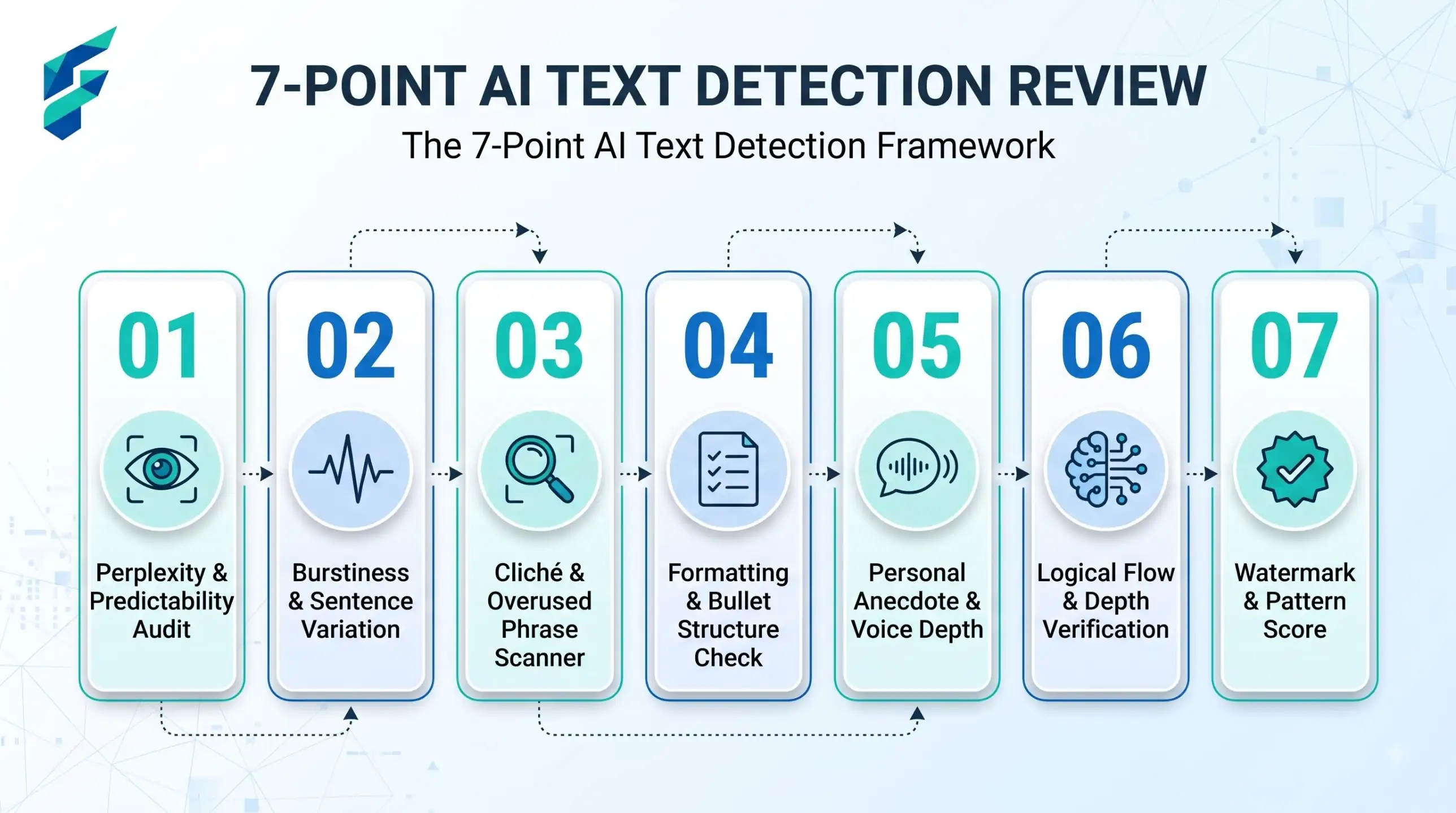
Someone sends you an essay, a cover letter or a blog post, and a small voice asks: did a person write this? Free AI-text checkers promise an answer. They cannot give one. This page explains why, and gives you a better free method: a 7-point review, a prompt that finds weak spots, and a fair process. If you are a writer afraid of a false flag, there is a section for you too.
Please note: this page is not legal or HR advice. If you work in a school or a company, your school or company policy comes first. Ask the person who owns that policy before you act.
Why an AI-text score is only a hint
An AI-text checker looks at patterns in words and guesses how likely a machine wrote them. A guess is not evidence. Detector makers, schools and researchers have all reported that these tools can be wrong in both directions:
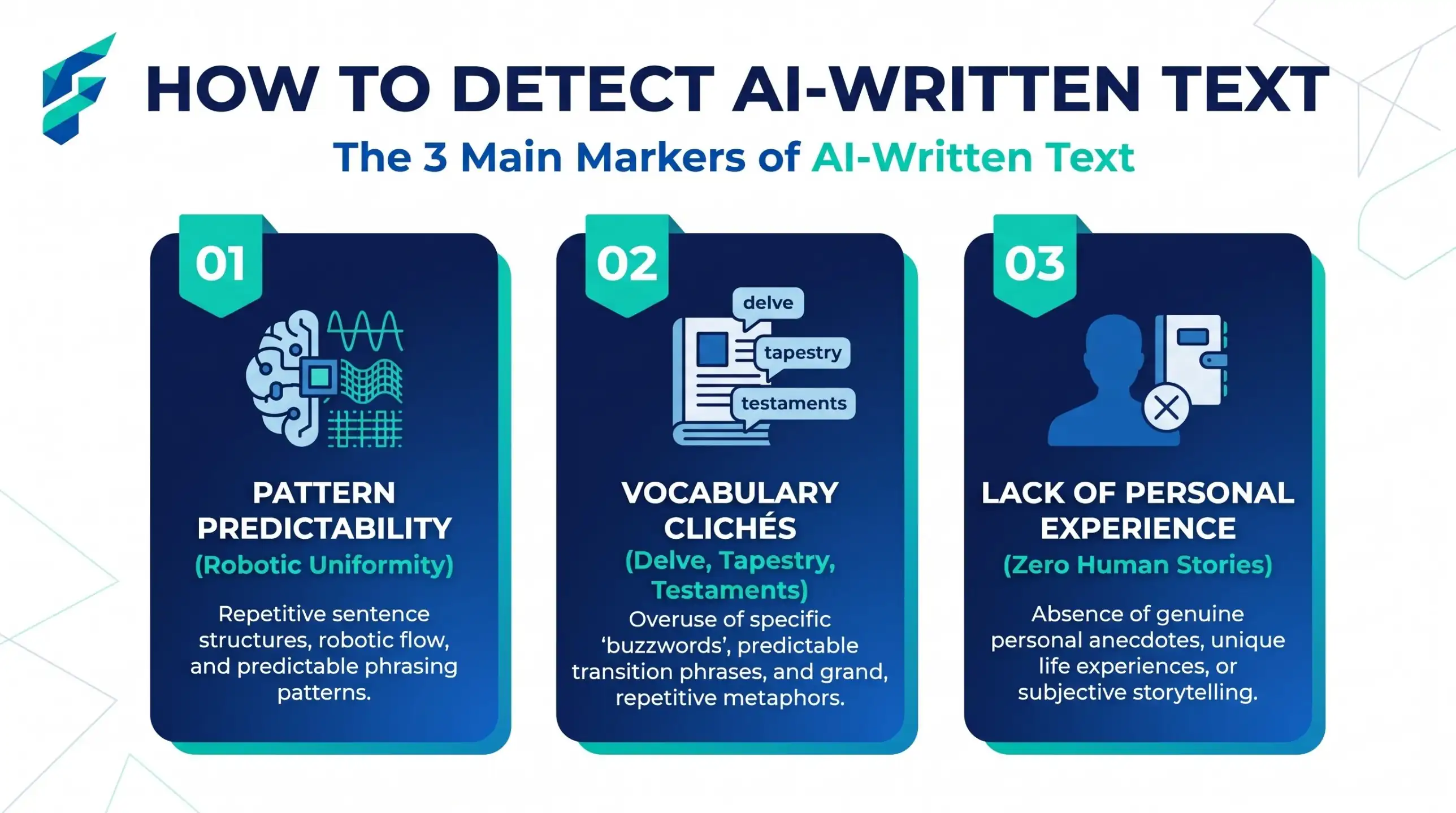
- False alarm. Human writing can be flagged. Plain, careful or formal writing is a common worry, and so is writing by people who learned English as a second language.
- Miss. AI text that a person edited, or that was reworded, can pass as human.
- Different answers. Two checkers can give two different scores for the same text.
So use a free checker, if you use one at all, as a reason to look closer. Never use it as the verdict. The rest of this page is about the looking.
The 7-point human review
Read the text slowly. Mark each point yes, no or unsure. One "yes" means nothing. A pattern across several points is worth a conversation.
| # | Check | What to look for |
|---|---|---|
| 1 | Specific details | Does the text contain things only the writer would know: a place, a name, a date, a small surprise? |
| 2 | Errors in facts or names | Check a few names, dates and numbers. Chatbots can state wrong facts in a confident voice. |
| 3 | Repeated sentence shapes | Do many sentences start or end the same way? Are paragraphs all the same length? |
| 4 | Vague claims | Phrases like "many experts agree" or "it is widely known" with nothing behind them. |
| 5 | No sources | Claims that need a source but have none, or sources you cannot find. |
| 6 | Tone mismatch | Compare with the same person's earlier work. A sudden change in voice is a clue, not proof. People improve, and editors change text. |
| 7 | No personal view | Does the writer take a side, give an opinion or admit a doubt? Or is it all smooth and neutral? |
Notice that every point is about the quality of the text. A weak, vague, unsourced piece is a problem whether a human or a machine made it. That is the useful way to think about it.
Prompt 1: ask for weak spots, not for a verdict
Do not ask a chatbot "is this AI?". It will answer with confidence, and it cannot know. Ask it to find vague or unsupported claims instead. That is something it can actually do, and you can check its answer. Do not paste private or confidential text into a free tool unless its privacy page allows it.
Read the text below. Do NOT say whether a human or an AI wrote it.
Instead, list: (1) claims that are vague, (2) claims that need a source but have none,
(3) facts, names or numbers I should verify, (4) places where a personal detail or example is missing.
Quote each part exactly and keep each note to one line.
Text: [paste text here]
Then check the flagged parts yourself. The chatbot can be wrong too.
Ask for drafts, notes and a short live sample
The fairest evidence comes from the writer, not from a tool. Writing involves a trail: notes, outlines, earlier drafts, saved versions with dates, and the sources the person read. Most writers have some of this. A short live sample, written while you watch or on a call, gives you a fair comparison of voice and level. Keep it small, around 10 minutes and one paragraph, and tell the person it is only to compare, not to punish.
Hi [name], thank you for sending [piece].
I have a few questions about how it was made. This is routine, not an accusation.
Could you share your notes, outline or earlier drafts, and the sources you used?
It would also help if you could write one short paragraph on [topic] in about 10 minutes.
Please tell me if another format works better for you.
A fair process: what to do and what to avoid
| Step | Do | Do NOT |
|---|---|---|
| You have a doubt | Run the 7-point review and write down what you saw | Decide from a score alone |
| You want more information | Ask politely for drafts, notes and sources | Accuse, or tell other people first |
| The answer is unclear | Offer a short live sample and a chance to explain | Fail a student for it alone, or reject a candidate on a score alone |
| You still doubt | Follow your written policy and ask the person in charge of it | Make up your own punishment |
| You decide | Base it on the weak work itself: errors, no sources, no match with the task | Say "the detector said so" as the only reason |
A worked example (fictional)
(Fictional) Mara runs a small furniture shop and is hiring a content writer. One applicant's cover letter is smooth but has no names and no numbers. A free checker gives it a high AI score. Mara does not reject the person. She runs the review. The letter claims "years of experience in leading brands" with nothing specific, and it names a company award that Mara cannot find. That is points 4 and 5.
She sends the polite message from above and asks for two published samples and a 10-minute paragraph on a product she picks. The applicant sends links to older articles, rough notes and a paragraph with a clear, plain voice. The award was a typing mistake, and the applicant explains it. Mara decides on the samples and the paragraph, not on the score. Another candidate who could not show any past work or explain a single claim would have been a harder case. Even then, she would decide on the missing evidence of skill.
If the text has these signs, here is the fix
| If the draft you received is... | Do this |
|---|---|
| Smooth but full of vague claims | Ask for one real example or number for each main claim |
| Using facts or quotes you cannot find | Ask for the source. Treat an unfindable source as an error to fix |
| Same sentence shape again and again | Ask the writer to rewrite in their own words, with their own example |
| Very different from earlier work | Ask what changed. A new editor, a new tool or more practice can explain it |
| Scored "likely AI" but passes the 7 points | Treat it as human work. Ignore the score |
When not to use AI for this:
Do not use a chatbot or a detector as the judge in a grade, a job decision, a contract dispute or a misconduct case. Their answers can be wrong, and a person may lose a mark, a job or a reputation. Use them only to point at parts of the text you then check yourself.
For writers: how to protect yourself
If you write for a class, an employer or a client, you can make a false flag easy to answer.
- Keep drafts. Use a tool that saves version history, or save a new file for each big change, with the date.
- Keep notes and sources. A simple list of links, books and interview notes is enough.
- Add what only you know. A real example, a name, a number you measured, an opinion you can defend.
- Tell people how you used AI. If you used a chatbot for ideas or grammar, say so, and check your policy first.
- Stay calm if flagged. Show your trail and offer a short sample. Say that checkers can be wrong.
If you publish a blog and use AI as a helper, the same habits make your posts better. See how to rank a blog post with AI tools and AI writing tools for small business. To judge any AI tool before you trust it, read how to choose the right AI tool.