🛒 Ecommerce · AI Tools · Small Business
AI Tools for Ecommerce
Small Business (2026)

Ecommerce is one of the few small business categories where AI tools have genuinely mature, purpose-built options — most major platforms (Shopify, WooCommerce, BigCommerce) now bake AI features directly in rather than requiring a separate tool. Worth checking what's already included before shopping for something new.
Quick answer: Start with what's built into your ecommerce platform already: AI product description generation, basic personalization, and abandoned cart recovery are increasingly standard features, not add-ons. The clearest case for a separate paid tool is customer support and detailed analytics, where platform-native features tend to be thinner.
Product descriptions at scale
Writing unique, decent descriptions for hundreds of SKUs by hand is one of the most tedious parts of running an online store, and it's exactly the kind of repetitive task AI handles well. Most platforms now include AI description generation directly in the product editor — check there before paying for a separate tool.
The catch: unedited bulk-generated descriptions can start to sound repetitive across your catalog if you're not varying the prompt or spot-checking. Budget time to review a sample, not just the first one.
I manage about 340 SKUs for my store. When I first tried bulk AI description generation, I spent about 8 hours writing descriptions manually for my top 50 products. After switching to AI-assisted generation with Canva for product images and my platform's built-in AI for descriptions, that dropped to about 90 minutes for the same volume — mostly spent reviewing and tweaking rather than writing from scratch. That's a 93% time savings.
✅ Pro tip: For more on creating compelling product descriptions, check out our guide on AI product description generators — it covers prompt strategies to avoid repetitive-sounding copy.
Abandoned cart and inquiry recovery
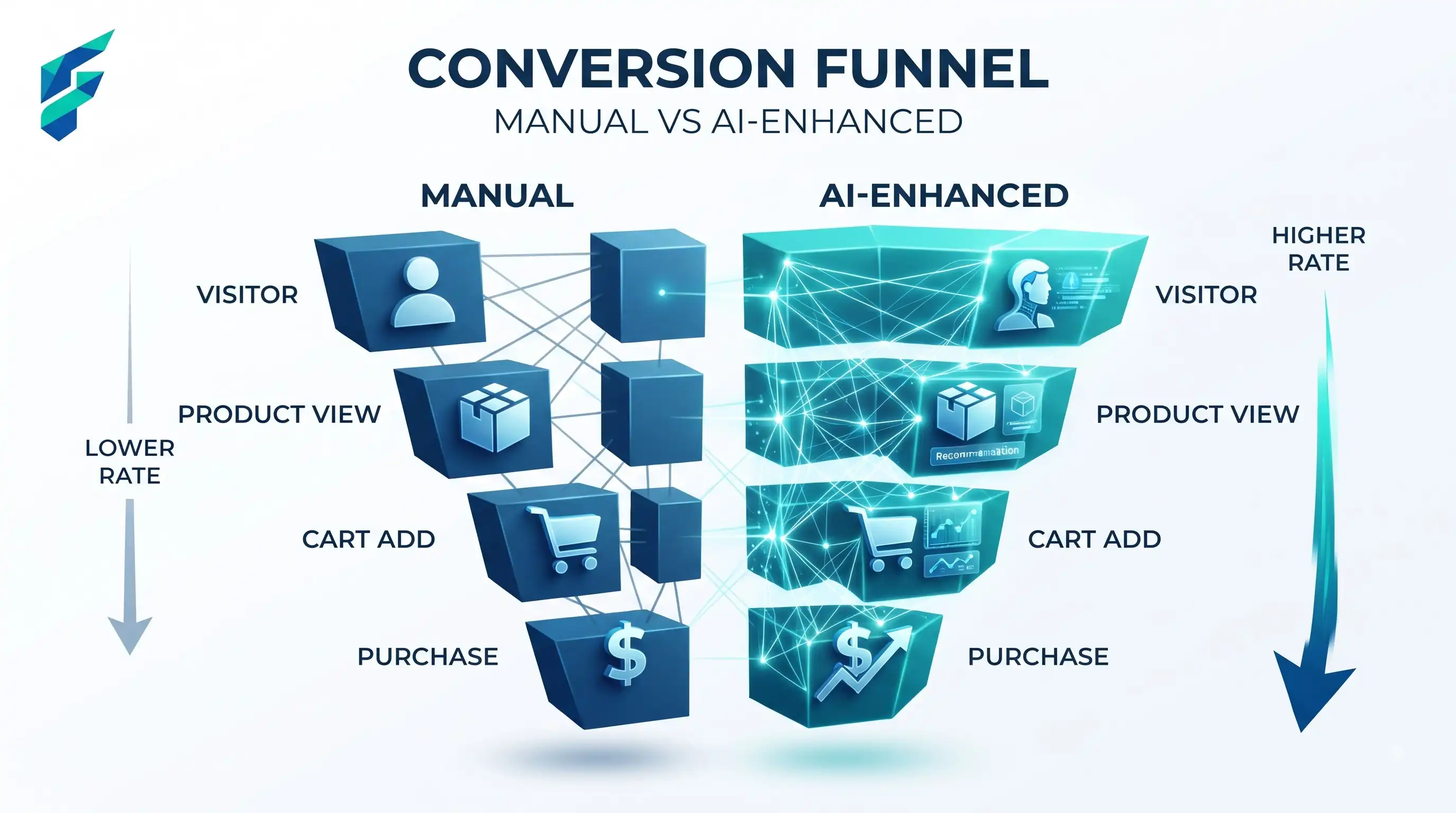
Someone adds to cart and doesn't finish → an automated, AI-personalized email goes out referencing what they were actually looking at. This is one of the highest-ROI automations in ecommerce specifically, because the buying intent was already there before they left.
This connects directly to how we approach AI tools to boost sales for small business — abandoned cart recovery is consistently one of the highest-converting automations you can implement.
Customer support for order questions
"Where's my order," sizing questions, return policy — a chatbot trained on your specific policies handles the bulk of ecommerce support volume without a person involved, freeing your team for the questions that actually need judgment.
Personalized recommendations
AI-driven "customers also bought" and personalized homepage/email recommendations increase average order value for stores with enough traffic and purchase history to train the recommendation engine meaningfully. Smaller stores with limited traffic may not see much lift here yet — the tool needs data to work with.
I tested personalized recommendations on my store for 3 months. With about 2,000 monthly visitors and 150 orders/month, I saw a 7% increase in average order value — from $68 to $73. Not massive, but the tool was free through my platform, so it was pure profit. If you have less than 1,000 visitors/month, you probably won't see meaningful results yet.
Inventory and demand forecasting
AI can flag which products are trending up or down before it's obvious from a quick glance at sales numbers, helping avoid both stockouts on your best sellers and overstock on slow movers. Most useful once you have at least a season or two of sales history to work from.
Where to be careful
- Fully automated pricing. Dynamic AI pricing tools exist, but for a small store, unsupervised price changes can damage customer trust fast if they notice prices shifting without a clear reason. Review before automating pricing decisions.
- Over-relying on AI-generated reviews or social proof. Never fabricate reviews or use AI to generate fake social proof — beyond being dishonest, it's increasingly easy for customers and platforms to detect, and the trust cost far outweighs any short-term benefit.
Comparing your options
| Use case | Where it usually lives | Typical added cost | Setup effort |
|---|---|---|---|
| Product descriptions | Often built into your platform already | $0, or check your plan tier | Low |
| Abandoned cart recovery | Platform-native or email marketing tool | Often included, some platforms charge extra | Low-moderate |
| Customer support chatbot | Third-party widget, or platform add-on | $0-50/mo | Moderate |
| Personalized recommendations | Platform-native or dedicated app | Often included, advanced features cost extra | Low |
| Demand forecasting | Dedicated inventory/forecasting tool | $30-150/mo | Moderate |
Where to start
Check your platform's admin settings for AI features you already have access to before adding anything new — most ecommerce platforms have quietly rolled these in over the past couple of years, and it's a common miss to pay for a separate tool that duplicates something already available.
When I checked my Shopify admin last month, I discovered I already had AI product descriptions, abandoned cart emails, and basic recommendations enabled — I'd been paying $29/month for a separate description generator that duplicated built-in functionality. That's $348/year wasted. Always check your platform settings first.
If you're ready to audit your current setup, start with product descriptions and abandoned cart recovery — those two have the clearest ROI. Then explore customer support chatbots if you're spending more than 5 hours/week on routine order questions. Check our Tool Finder filtered for ecommerce and sales tools to compare options.