🎓 Career Development · AI Productivity · Freshers
Practice Job Interview Questions With a Free AI Tool
(5-Round Script)
The best interview practice is saying your answers out loud to someone who answers back. Most people do not have that person. A free chatbot can be that person if you set the rules properly. Without rules, it just throws a list of questions at you and tells you every answer is great. That does not help.
Set up the interviewer
Paste this at the start of a new chat. Fill in the brackets.
Act as a strict but fair interviewer for the job: [job title] at a [type of company].
Here is the job description: [paste].
Rules:
- Ask ONE question at a time and wait for my answer.
- After each answer, give me: a score out of 5, what worked, what was weak, and a better version of one sentence.
- Do not praise me unless the answer is really good.
- Ask follow-up questions like a real interviewer would.
- After 5 questions, give me a summary of my 3 biggest weaknesses.
Begin with the first question.
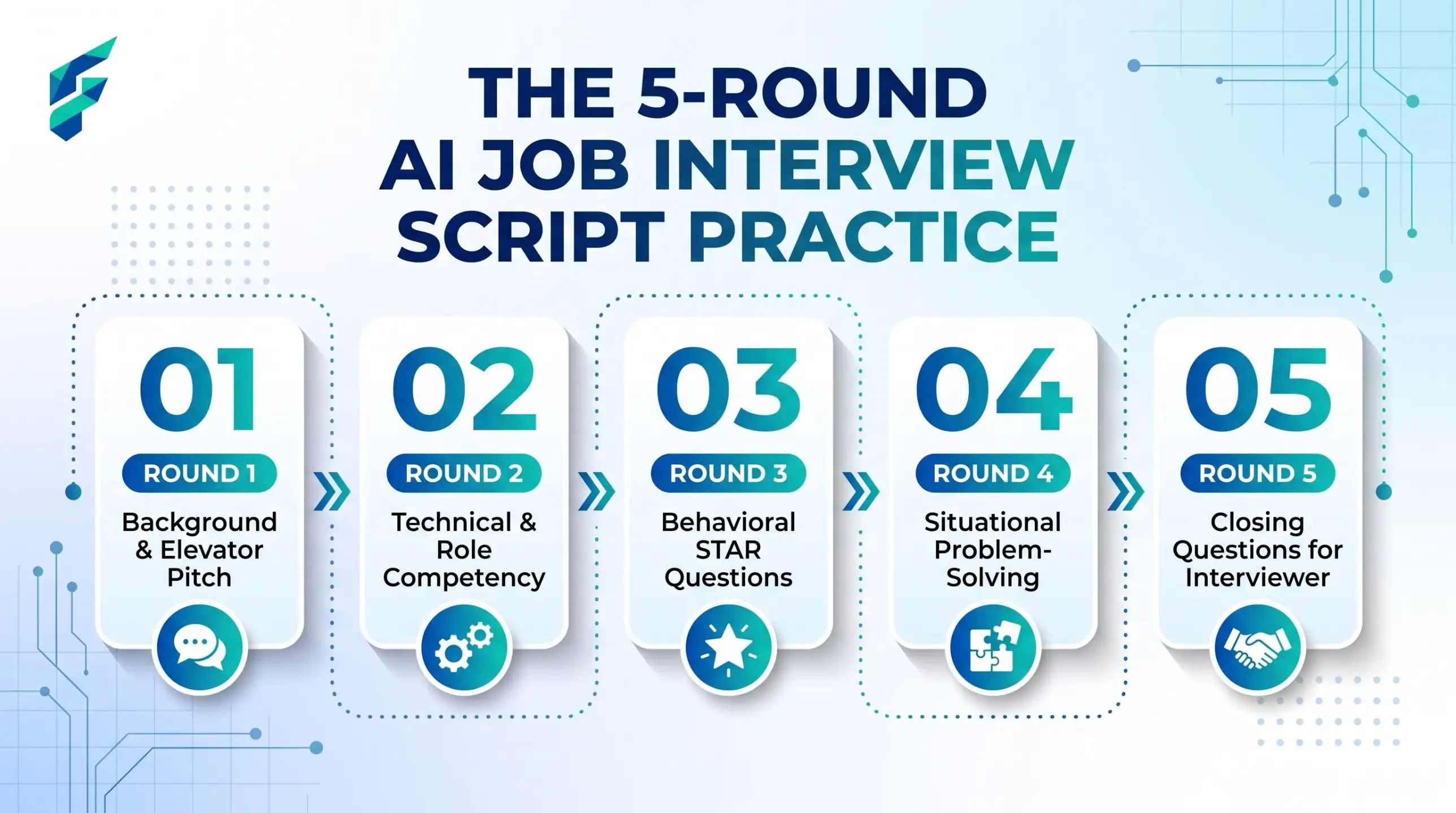
The 5-round script
Do these in order, one per sitting if you like.
| Round | Focus | Time |
|---|---|---|
| 1 | "Tell me about yourself" | 10 min |
| 2 | Why this job and company | 10 min |
| 3 | Behaviour questions (STAR) | 15 min |
| 4 | Job skill questions | 15 min |
| 5 | Hard questions: weakness, gap, salary | 10 min |
The STAR method in one minute
For questions like "Tell me about a time you faced a problem", answer in four steps:
- Situation: where and when, one sentence.
- Task: what you had to do.
- Action: what YOU did (not "we").
- Result: what happened, with a number if you have one.
Example: "In my final-year group project, our teammate left two weeks before the deadline (S). I had to finish his part of the database (T). I learned the missing tool in two evenings and rebuilt it (A). We submitted on time and got the second highest marks in class (R)."
Tell the AI: "Rewrite my answer in STAR order and keep my facts."
Question bank for three job types
Round 4 is where you test the skills of the job itself. Ask the AI to focus on questions like these. They are starting points, so swap in the real tasks from your job description.
| Job type | Sample questions to practice |
|---|---|
| Customer support | "A customer is angry and the problem is not your fault. What do you do?" / "How do you handle three chats at once?" |
| Junior office or admin | "How do you decide what to do first when everything is urgent?" / "Tell me about a mistake you found in your own work." |
| Sales or retail | "How would you help a customer who says the price is too high?" / "What do you do when you miss a target?" |
Then use this second prompt to go deeper on one job type:
I am applying for [job title]. Give me 8 questions this interviewer might ask about the daily tasks of this job.
Start easy and get harder. After I answer each one, tell me if I sounded like I had really done it or only read about it.
Do not give me model answers until I ask.
How to answer "What salary do you expect?"
This question scares many people. Do not guess in the moment. Before the interview, find a fair range for the job in your city from job listings or people you know. Then practice a calm answer with the AI:
Act as an interviewer. Ask me about my salary expectation. I will answer.
My plan: say I have researched the role, give a range based on my research, and say I am open to talk about the full offer.
Tell me if my answer sounded confident or nervous. Do not give me any numbers. I will bring my own.
AI does not know pay in your city. It will guess, and the guess can be wrong. Use your own research.
If the AI gives you this, do this
| Problem | Fix |
|---|---|
| Every answer gets 5/5 | Type: "Be stricter. Score like a hiring manager who has 40 candidates." |
| Questions are too general | Paste more of the job description and name the company type |
| It gives long speeches | Say: "Questions and feedback only. Keep each reply under 80 words." |
| It forgets your rules | Start a new chat and paste the first prompt again |
| It invents details about you | Say: "Use only what I told you. Mark gaps with [ADD]." |
A 7-day practice plan
- Day 1: Run round 1. Write your "tell me about yourself" in four sentences.
- Day 2: Round 2. Find one real fact about the company and use it.
- Day 3: Write three true stories from school, work or volunteering. Put each in STAR order.
- Day 4: Round 3 with those stories. Fix the weakest.
- Day 5: Round 4 with the question bank for your job type.
- Day 6: Round 5. Practice the salary and gap questions out loud.
- Day 7: Full run of 5 questions without notes. Rest after.
Use only real experience. If you have no work history, use class projects, family business help or volunteering. If the interviewer finds an invented story, the interview is over. If you have a gap, practice a short, honest answer.
Questions people ask
Say it out loud
Reading the AI's feedback is not the practice. Speak the answer, then type or dictate it. If your phone can dictate text, use that. Then compare what you said to the better version.
Use a score sheet
| Question | My score | One thing to fix |
|---|---|---|
| Tell me about yourself | 2/5 | Too long, no job link |
| Why this company | 3/5 | Needs one real fact |
After three sessions your scores should rise. If they do not, change what you practice, not how many times.
What AI cannot do
It does not know the real interviewer, the company's culture, or what the panel is looking for. Use it for structure and confidence, then research the company yourself. Do not memorize AI answers word for word; they sound fake when repeated.
Keep practicing in the same job hunt
Before the interview you need a clear resume written with AI help and a good cover letter for your first job. To review your own practice, you can record yourself and turn it into text with the tools in AI meeting transcription tools, then read what you actually said.
Real-world example: The question I struggled with most was "Tell me about a time you failed." My initial score was 2/5 because I just said, "I failed a test but studied harder." After using the STAR method prompt, I rewrote it to focus on a specific group project where I missed a deadline, how I communicated it early, and the system I built to prevent it. My score jumped to 4.5/5 because it showed accountability and a real solution.