🎓 Career Development · AI Writing · Freshers
AI Tool to Write a Cover Letter for Your First Job
(With a Worked Example)
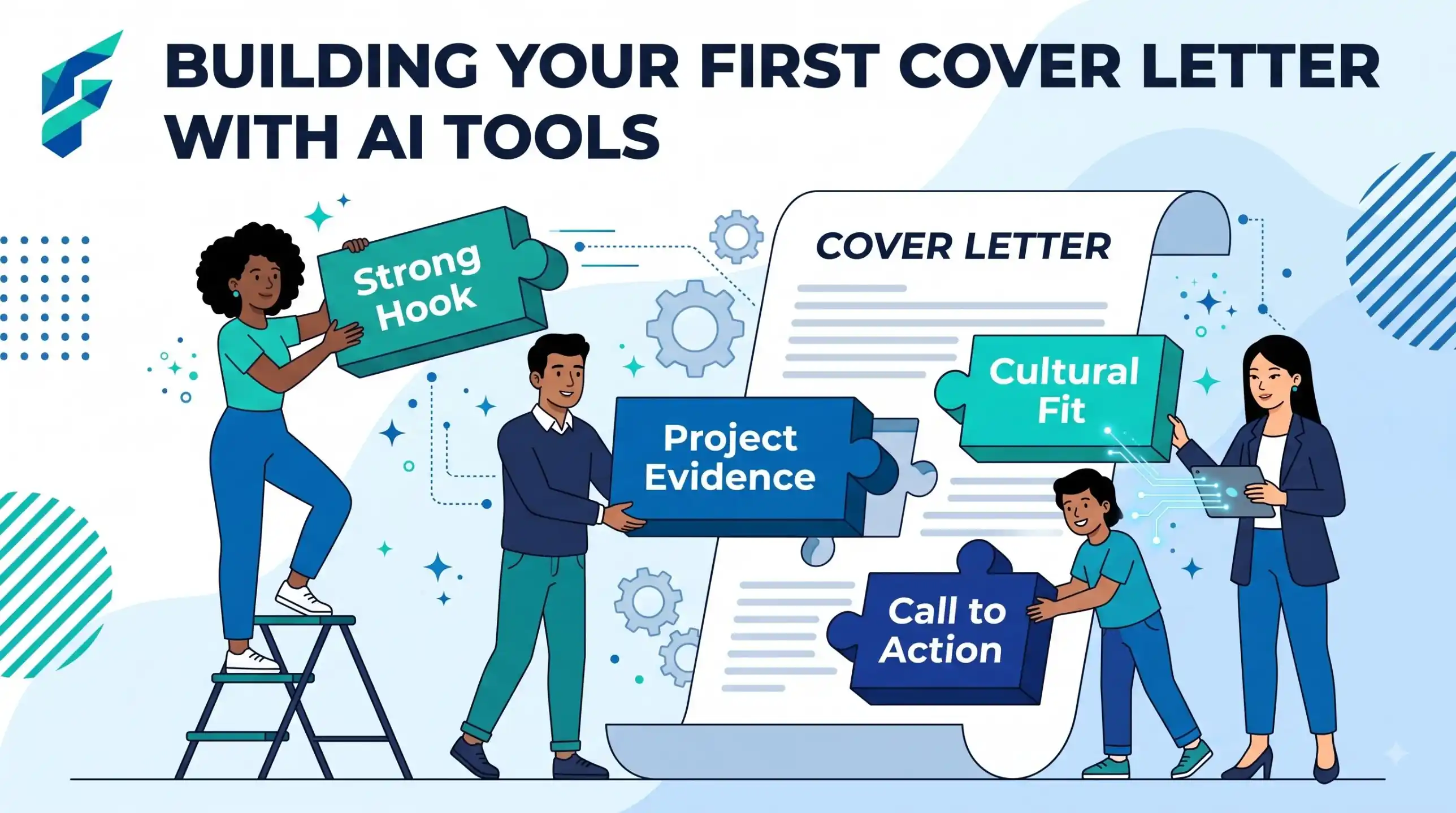
A cover letter for a first job has one problem: you do not have job experience to talk about. So most freshers fill the page with "I am a hardworking and passionate person". Recruiters have read that sentence thousands of times. What they have not read is a short letter that shows you understood their job and have a small proof you can do part of it. AI can help you write that letter, but only if you hand it the proof.
The four paragraphs
Think of it as four short answers, not one long essay.
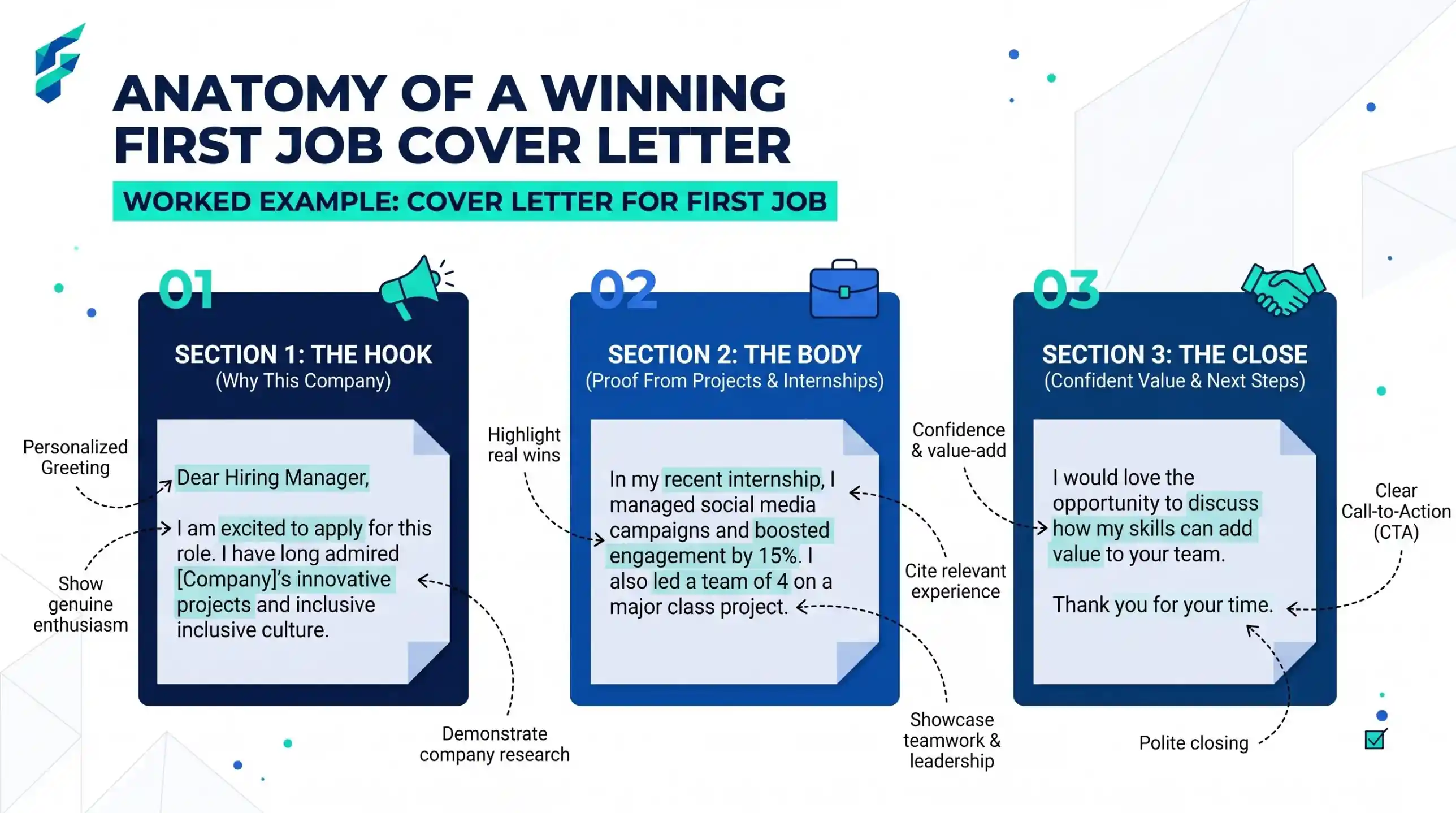
- Why this job, this company (2 sentences). Something specific you noticed.
- Your best proof (3 sentences). One project, class task or club role that matches the job.
- What you will bring (2 sentences). Linked to what they asked for in the job post.
- Close (1-2 sentences). Say you are available and thank them.
Total: about 180 to 250 words. One page at most.
A full example (made-up, to show the shape)
Dear Ms. Rao,
I am applying for the Junior Content Writer role at GreenLeaf Foods. I read your recipe blog and noticed most posts do not include prep time, so I tried adding it to two of them to see how it would read (my version is linked below).
In my final year I ran my college food club's Instagram page, growing it from 300 to about 1,100 followers in four months by posting one recipe reel a week and replying to every comment. I wrote all the captions and used a simple spreadsheet to track which posts got saved.
Your job post asks for someone who can write clearly and take feedback. I did both in my club, where two senior members edited my captions each week. I would like to do the same for your team.
I am available from 1 July and can send more writing samples. Thank you for reading.
Priya Nair
Notice what it does: it points to a real observation, uses numbers, and quotes the job post back. That is what to ask AI to copy, not the exact words.
A second example: when your proof is not from a job
Not every fresher ran a social media page. Here is a made-up paragraph two for a commerce graduate applying for an accounts assistant role:
"For my final-year project I recorded the monthly income and expenses of my uncle's hardware shop in a spreadsheet for six months. I found that about one fifth of his spending went on one supplier, and I showed him a simple chart. He now compares prices from two suppliers each month."
Class work, family help, a club or a small volunteer task can all be proof. They only need to be true, small and specific. If you have none of these yet, do one small real task this week and write about that.
Prompt (copy and paste)
Write a cover letter for my first job, 200 words, 4 short paragraphs.
Job: [title] at [company]. Key requirements from the post: [paste 3-4 lines].
Something specific I noticed about the company: [one fact].
My best proof (project, class work, club role): [facts, with real numbers if I have them].
Skills that match the job: [list].
Voice: polite, plain, a bit warm. No "hardworking", "passionate" or "team player".
Do not invent any experience or numbers. Use [ADD] where I should fill in a detail.
A second prompt: if you do not know what to write
Start with questions, not a draft. This helps when your mind is blank.
I am applying for [job title] at [company]. I am a fresher with no job experience.
Here is the job post: [paste].
Ask me 5 questions, one at a time, to find the best true story from my college,
projects or volunteering that matches this job.
Wait for my answer after each question. Do not write the letter until I say "write it".
Answer in short, honest sentences. When you say "write it", the draft will be built from your own words.
If the AI gives you this, do this
| Problem | Fix |
|---|---|
| The letter is 400 words | Ask: "Cut to 220 words. Keep paragraph 2." |
| It says "I am a perfect fit" | Replace with one fact that shows fit |
| It repeats your resume line by line | Ask for one story, not a list |
| It praises the company in big words | Ask for one plain, true sentence about what you noticed |
| It invents a skill or number | Delete it. Re-prompt with "use [ADD] for any detail I did not give" |
When NOT to use AI for this:
• When the job post says "no cover letter needed". Do not send one.
• When you are applying by short message or email form. A 3-line note is better.
• When the AI draft has nothing in it that is only about you. Add your real story first.
What to check in the AI's draft
| Look for | Fix |
|---|---|
| Any claim you can't prove | Delete it |
| Words you would never say | Replace with your own |
| A paragraph that could fit any company | Add one detail about this company |
| Company name and job title | Spelling must be exact |
| "To Whom It May Concern" | Find a name, or write "Dear Hiring Team" |
Before you send: a checklist
- The job title and company name are spelled exactly right.
- You can explain every sentence if asked in an interview.
- The file is a PDF named "YourName-CoverLetter.pdf".
- You read it aloud once, and nothing sounded like someone else.
Send a different letter each time
The biggest waste is one letter sent to 30 companies. Change the first paragraph and the third paragraph every time. That is 5 minutes of work and the part that gets read.
Build the rest of your application
The letter works with a clear resume, so see how to write a fresher resume with AI, and then practice interview questions with AI. The same "problem, plan, proof" thinking is used in AI tools for writing business proposals, if you later pitch work as a freelancer.
Real-world example: A cover letter I wrote using this method for a junior marketing role highlighted a specific college fest sponsorship I secured. Instead of saying "I am a great communicator", I wrote: "I secured a ₹15,000 sponsorship from a local cafe by presenting a 3-slide deck on student footfall." I got a reply within 24 hours asking for an interview, proving that specific proof beats generic claims every time.