📊 Customer Feedback · AI Writing · Small Business
AI Tool to Write Customer Survey Questions
(Free Prompts)
Most small business surveys fail before the first customer answers. The questions are the problem. A free chatbot can write good ones, if you tell it what decision you want to make.
Three bad questions, taken apart
A chatbot will happily write these if you just say "make me a survey". None gives answers you can use.
1. The leading question
Bad: "How much did you enjoy our friendly, fast service?"
It tells the customer what to feel.
Fixed: "How would you rate our service speed today?" (1 = very slow, 5 = very fast)
2. The double-barrelled question
Bad: "Was the staff polite and was the price fair?"
It asks two things. If someone says "no", you do not know which one.
Fixed: Two questions. "How polite was the staff?" and "How fair did the price feel?"
3. The vague question
Bad: "What do you think of us?"
You get "good" or "ok". Nothing to act on.
Fixed: "What is one thing we should change to make you come back sooner?"
Rule: one question, one idea, no hints, and the answer must lead to an action.
Which question type fits which job
| Type | Example | Use it when | Watch out |
|---|---|---|---|
| Rating (1 to 5) | "How easy was it to order?" | You want to compare over time | Always label both ends |
| Multiple choice | "How did you find us?" | You know the likely answers | Add "Other" |
| Open text | "What almost stopped you from buying?" | You want reasons, in their words | Ask for only one or two |
| Yes/no | "Did you get what you came for?" | You need a clear fact | Does not tell you why |
Three example surveys (copy and change)
These are examples. Change the words to match your business.
(a) A shop: example
1. How did you hear about our shop? (Friend / Instagram / Passing by / Other)
2. Did you find what you came for? (Yes / Partly / No)
3. How easy was it to find things? (1 to 5)
4. What is one product you wanted but did not see?
5. What is one thing we should change?
(b) A service business, such as a salon or repair service: example
1. How easy was it to book? (1 to 5)
2. Did we start on time? (Yes / Up to 15 minutes late / More than 15 minutes late)
3. How clear was the price before we started? (1 to 5)
4. What was the best part of your visit?
5. What would make you book again sooner?
(c) A course or online product: example
1. What was your main reason for joining?
2. Which part did you finish? (All / Most / Half / Little / None)
3. How useful was it for your goal? (1 to 5)
4. Where did you get stuck or stop?
5. What should we add or remove?
A prompt that builds a survey from your goal
Start with the decision. "Why do people not come back?" is a goal. "A customer survey" is not.
You are helping a small business owner write a short customer survey.
My business: [what you sell, where, who buys]
My goal: [the one decision this survey should help me make]
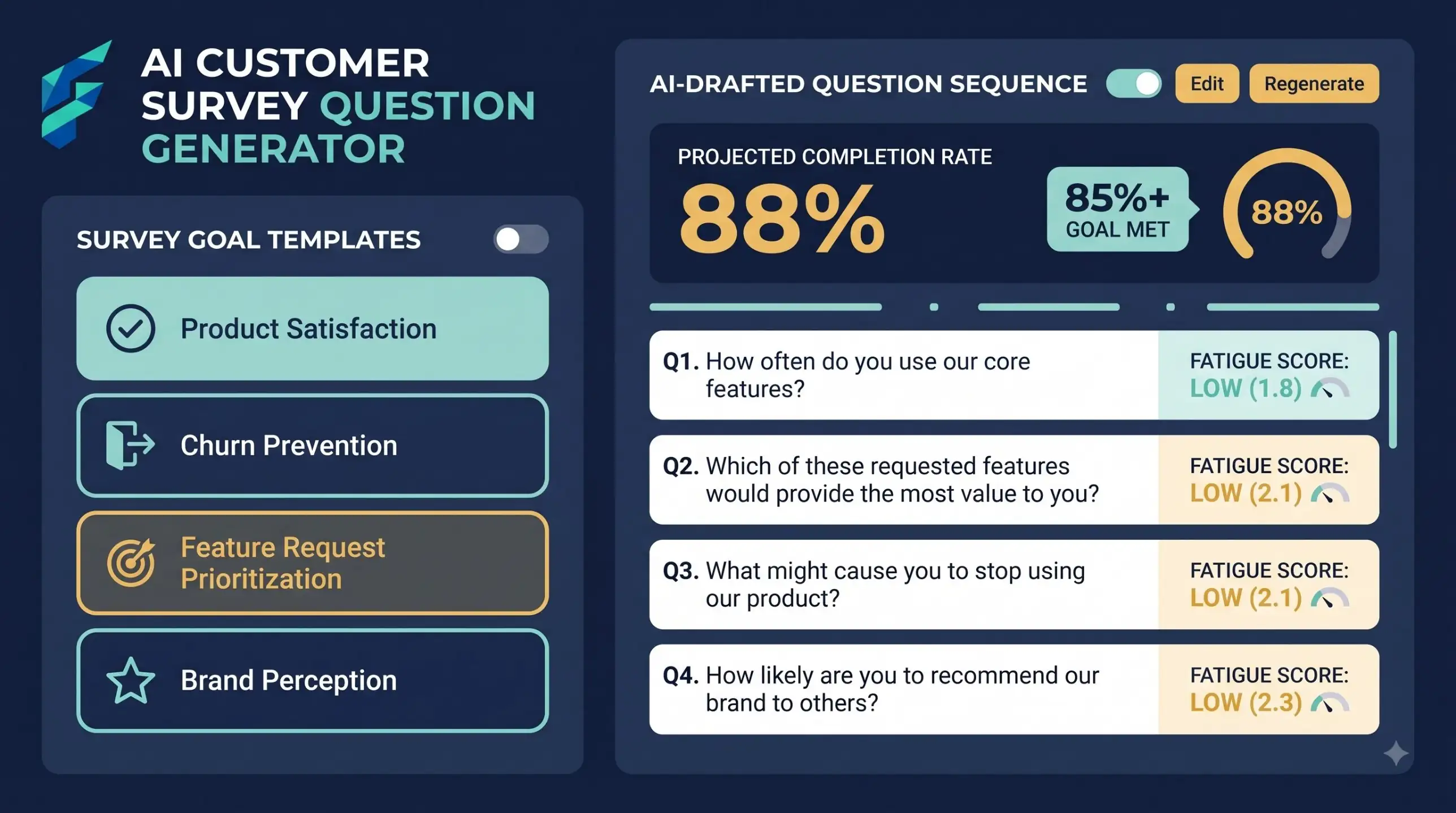
Write exactly 5 questions. Use a mix of rating, multiple choice and open text.
Rules: one idea per question, no leading words, no words like "amazing" or "friendly",
label both ends of every rating scale, add "Other" to multiple choice.
After each question, write one line: what I can decide from the answers.
Do not ask for names, phone numbers or emails.
Real-world example: For my own freelance web design business, I used this prompt with the goal: "decide whether to offer a monthly maintenance retainer." The AI suggested asking, "How confident do you feel updating the website yourself?" The answers clearly showed 80% of clients felt overwhelmed, which directly led to me launching a successful $50/month care plan.
Troubleshooting: what the AI gives you and what to do
| If the AI gives you | Do this |
|---|---|
| 12 questions | Say: "Cut to 5. Keep the ones that help my goal." |
| Words like "delighted" or "amazing" | Say: "Rewrite in neutral words. No feelings in the question." |
| Two ideas in one question | Say: "Split any question with the word 'and'." |
| A rating with no scale labels | Ask for "1 = ..., 5 = ..." on every rating |
| Questions that ask for personal data you do not need | Delete them and repeat the "no names, phones or emails" rule |
How to send it, and how many people to ask
Pick the place where your customers already are.
- WhatsApp: Good for small, local customers. Send one link or the five questions as a message. See our page on AI tools to write WhatsApp Business messages for the invitation text.
- Email: Good for online buyers.
- QR code: Good for a shop or table. Put it on the receipt or counter. Make a free QR code for your form link.
For a first round, ask 30 to 50 people who bought recently. If one complaint repeats, you have your answer.
Read the answers with AI (without risking privacy)
A chatbot is good at finding patterns in many short answers. It is bad at counting unless you make it prove its work.
First, make the answers anonymous. Remove names, phone numbers, emails, order numbers and any detail that identifies a person. Then paste only the text answers.
Below are anonymous customer answers to one survey question: "[question]".
1) Group them into at most 5 themes.
2) For each theme, tell me how many answers belong to it and quote the exact words from at least 2 of those answers.
3) List any answer that does not fit a theme.
4) If you are unsure about a count, say so. Do not guess.
Answers:
[paste]
Then check two themes yourself by searching the answers. If a count is wrong, tell the AI. For bigger data, see AI data analysis tools for small business and, for numbers in a sheet, AI analytics tools for small business.
Worked example (fictional)
Imagine a small tailoring shop. The owner asks 40 customers, "What is one thing we should change?" She pastes 40 anonymous answers into a chatbot. It returns a theme, "waiting for alterations", with 14 answers and two quotes. She searches the sheet and finds 13. Close enough. She adds a fixed pick-up day and asks again next month.
Privacy: ask for less
Collect only what you will use. No need to call someone back? Do not ask for a phone number. Tell people in one line why you ask. Do not paste identifying data into a chatbot. Privacy rules differ by country, so check yours. If you publish a policy, see our guide on writing a privacy policy for a small website.
When NOT to use AI for this:
• When you have fewer than 10 customers. Talk to them.
• When the topic is sensitive, such as a complaint or a health matter. Call the person.
• When you do not know your goal yet. The AI will only make a longer survey.
Common questions