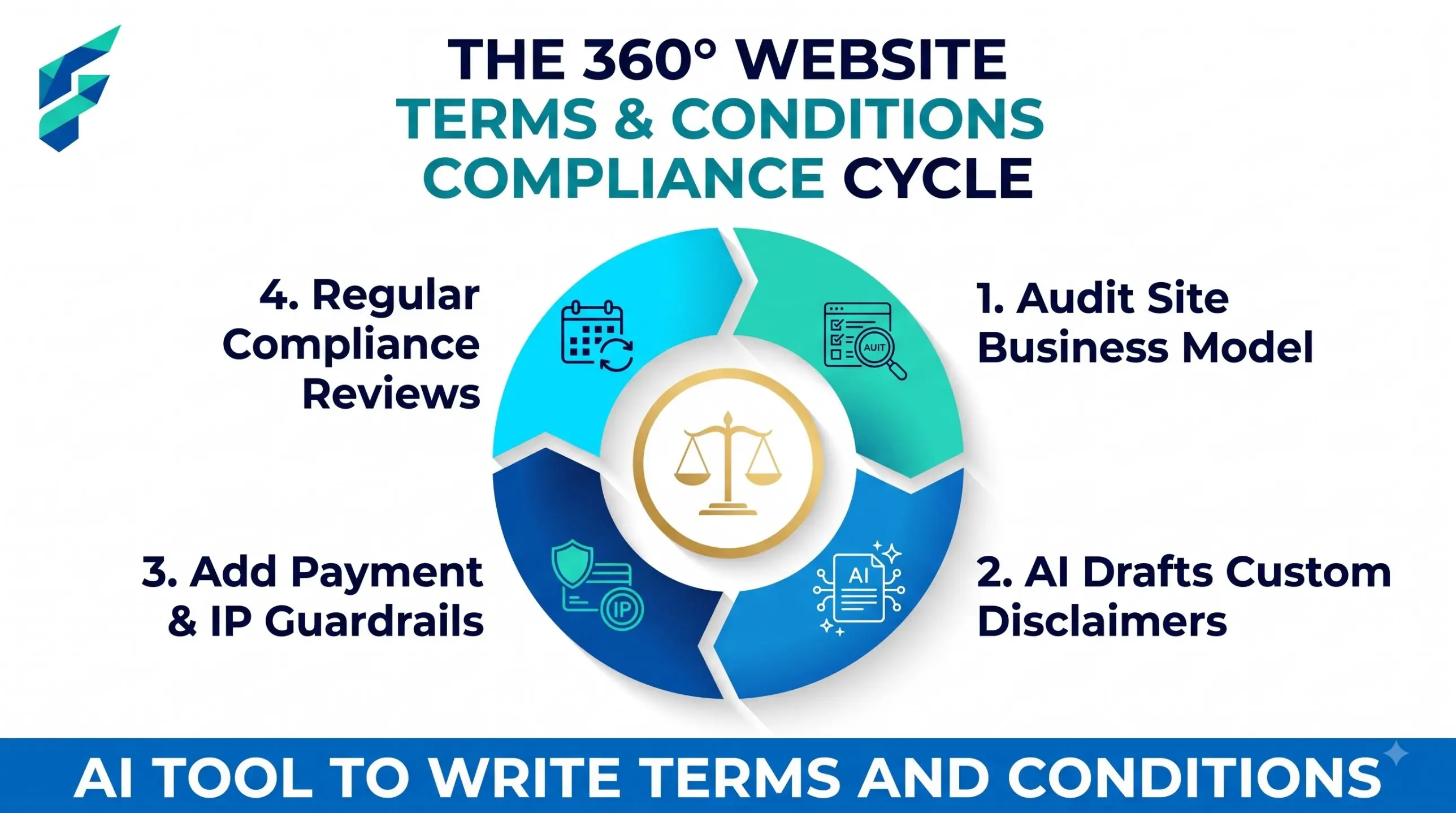
⚖️ Legal · AI Writing · Small Business
AI Tool to Write Terms and Conditions for a Small Website
A free chatbot such as ChatGPT, Claude or Gemini can draft terms and conditions for your small website. But it only knows what you tell it. If you give it no facts, it invents them. This article shows how to give it real facts and how to check the result.
This is not legal advice. We are not lawyers. Rules are different in every country, and they change with what you sell and who you sell to. Use AI for a first draft. You are responsible for what is on your site.
What terms and conditions are (and are not)
Terms and conditions (also called T&C or terms of service) are the rules between you and the people who use your site or buy from you. They answer simple questions. What do you offer? What if something goes wrong?
They are not a privacy policy. A privacy policy explains what you do with personal data. If you need one, read our guide on an AI tool to write a privacy policy for a small website. A rule in your terms does not beat the law of your country.
The 8 clauses a small site usually covers
| # | Clause | Plain meaning |
|---|---|---|
| 1 | Who you are | Your business name, country and how to find you |
| 2 | What you sell or offer | What the customer gets, in simple words |
| 3 | Payment and refunds | When people pay, how, and when they can get money back |
| 4 | Delivery or service rules | How and when the product or service reaches them |
| 5 | User conduct | What people must not do on your site |
| 6 | Your content and theirs | Who owns the texts, images and files |
| 7 | Limits of responsibility | What you do not promise, so far as your local law allows |
| 8 | Contact and changes | How to reach you, and how you tell people about new terms |
Clause 7 is the one AI writes with the most confidence and the least reason. Its strong words ("we are never liable") may not be valid in your country. Mark it for a professional to read.
Step 1: Collect your real facts first
Before you open a chatbot, write short answers to these:
- Legal name or trading name, and country.
- What exactly you sell. Product, service, download, booking?
- Price, currency, and payment method.
- Your refund or cancellation practice, with real days and numbers.
- How and when you deliver.
- A contact email that you read.
If a fact does not exist yet, decide it first. If you sell products, our guide to AI tools for ecommerce small business can help with the shop side.
Real-world example: For my own digital products, my real rule is: "Refunds are only issued within 7 days if the file fails to download or is corrupted, not for change of mind." I had to explicitly tell the AI this, or it defaulted to a generic 30-day policy.
Step 2: The clause-by-clause prompt
Copy this prompt. Replace the brackets with your facts.
You are helping me draft terms and conditions for a small website.
Use ONLY the facts below. Do not add facts, laws, numbers or promises that I did not give you.
If a clause needs a fact I did not give, write [ADD: what is missing] instead of guessing.
Facts:
- Business name and country: [ ]
- What we sell or offer: [ ]
- Payment methods and when payment is taken: [ ]
- Refund and cancellation practice: [ ]
- Delivery or service rules: [ ]
- User rules (comments, uploads, accounts): [ ]
- Who owns the content: [ ]
- Contact email: [ ]
Write these 8 clauses in this order: who we are, what we offer, payment and refunds,
delivery or service rules, user conduct, content ownership, limits of responsibility,
contact and changes.
Style: short sentences, simple words, a reader who is not a lawyer.
Do not name any specific law. Mark the limits-of-responsibility clause with [LAWYER CHECK].
Every [ADD] is a gap. Fill it with a true fact or remove it.
Worked example (fictional)
This is an invented business, only to show how it works. "Nila Prints" is a one-person shop that sells printed posters.
| What the owner told the AI | What the draft said |
|---|---|
| Posters ship in 5 working days | "Orders ship within 5 working days." Correct |
| Returns accepted for damaged items only | "You may return any item within 30 days." Wrong |
| Payment by card through a payment provider | "Payment is taken at checkout by our payment provider." Correct |
The AI added a 30-day return that the owner never gave. She caught it by checking each line against her real practice.
Step 3: The mismatch check
Put the draft next to your real practice. Look for every place where they disagree.
| Draft says | Your real practice | What to do |
|---|---|---|
| Refunds within 30 days | You refund only damaged items | Change the draft to match, or change your practice |
| "We never share your information" | You use an email tool and a payment provider | Delete the promise |
A promise you cannot keep is a trap. A customer can point to it.
If the AI gives you this, do this
| If the AI gives you... | Do this |
|---|---|
| A law name you never mentioned | Delete it. Ask a professional if it applies to you |
| Refund days you did not give | Replace with your real rule |
| "We are not responsible for anything" | Mark for a lawyer. This may not be valid where you live |
When to hire a lawyer
An AI draft can start a small hobby site. It is not enough when:
- You sell to consumers (private buyers). Many countries give them rights that you cannot remove with your terms.
- You take payments directly on your site.
- You sell in several countries.
- You deal with health or money services.
In these cases, use the AI draft as your notes. Bring it to the lawyer.
When NOT to use AI for this:
Do not use AI if you cannot explain your own refund, delivery and payment rules. Do not paste private customer data into a free chatbot.
Where to go next
A good FAQ page for your small business website can answer refund and delivery questions in simple words. Unsure which assistant to start with? Read how to choose the right AI tool.