🔤 Google Tricks · Anagram · Wordplay
Google Anagram Trick
(Did You Mean “Nag a Ram”?)
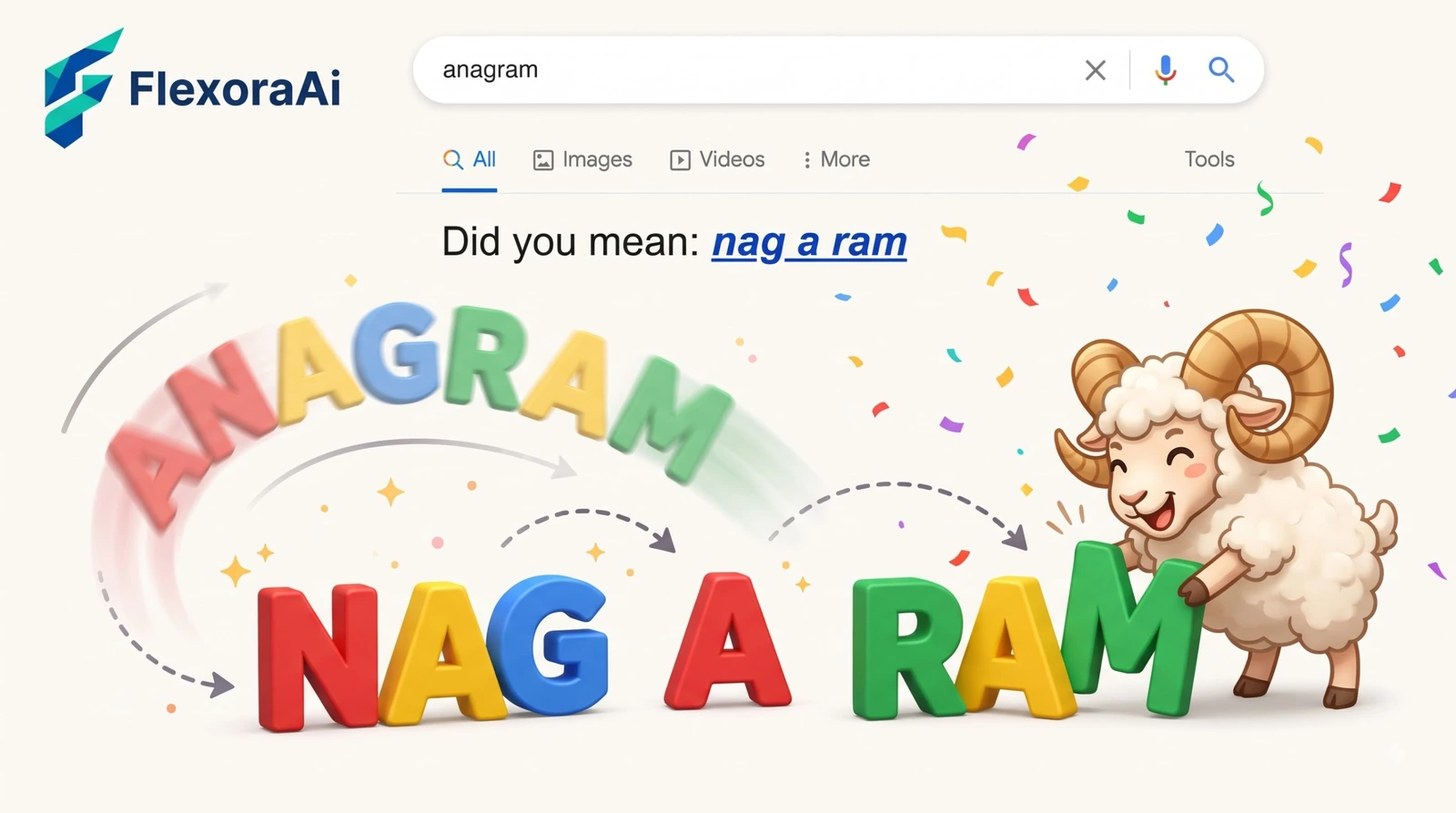
Most of Google’s tricks are loud. This one is a pun. You search for a single word, and the spelling suggestion at the top of the page turns out to be the same letters in a different order.
It’s a very small joke done very well. Here’s how to trigger it, why it lands, and what happens in other languages. It’s part of our Google search tricks list.
Quick answer: Search “anagram” on Google and it asks, “Did you mean: nag a ram?”, which is an anagram of the word itself. “Define anagram” gets “nerd fame again.” Older write-ups report translated versions in other languages, and recent roundups list the English trick as still working.
How to try the Google anagram trick
- Open google.com in any browser.
- Search
anagram. - Look just under the search box for the spelling suggestion.
- Now try
define anagramfor the second punchline.
You don’t need a special browser for this one. It’s a line of text, not an animation, which is why it has lasted so long.
Why the joke works
An anagram is a word or phrase made by rearranging the letters of another. Google’s “Did you mean” box normally fixes typos, so you expect a correction. Instead, it offers “nag a ram,” which uses exactly the same seven letters as “anagram.” The suggestion is the answer to its own question, and the joke only lands because the interface is so serious.
The “define anagram” twist
The second punchline is for people who read definitions. Search define anagram and Google offers “nerd fame again.” It’s a 13-letter rearrangement of “define anagram,” so the whole search phrase becomes an anagram, not just the word. Entrepreneur’s list of search tricks and Wikipedia’s list of Google Easter eggs both mention it.
Other languages
The joke was reportedly localized, with a rearrangement that works in each language. These examples come from older write-ups, so current behavior may vary by language and region:
| Interface language | Search word | Google suggests |
|---|---|---|
| English | anagram | nag a ram |
| French | anagramme | gare maman |
| German | Anagramm | Mama Rang |
| Dutch | anagram | ma graan |
| Swedish | anagram | magarna |
Count the letters if you don’t believe it. “Anagramme” and “gare maman” both use nine letters, and “Anagramm” and “Mama Rang” both use eight. Another roundup says the trick also works in Italian, Russian and Hebrew.
Build an anagram checker
To see the logic behind it, here’s a tiny JavaScript function. Two phrases are anagrams if their letters match after sorting, ignoring spaces and capitals.
Paste it into your browser console and test your own pairs. It runs on your own machine, so there’s nothing to install.
Find your own anagrams
A few classics to try the function on: “dormitory” and “dirty room,” “listen” and “silent,” and “the eyes” and “they see.” Part of the fun is how good anagrams tend to sound like a sentence that was written for the occasion.
If you like jokes hidden in a corner of the interface, there’s a longer tradition in Google’s April Fools pranks history. And for the best-known number joke on the search page, read the next post in this set, Google answer to life trick.
If it doesn’t show
- Search the word on its own, with nothing else in the box.
- Check your Google interface language. The English joke belongs to the English interface.
- Use regular Google Search rather than an app or special results view.
- Remember that Google can change suggestions at any time, so a missing joke isn’t a mistake on your side.
The rest of the status labels are in our complete list of Google Easter eggs.
Frequently asked questions
Google asks, “Did you mean: nag a ram?” The suggestion is an anagram of the word you searched.
It shows “Did you mean: nerd fame again,” a 13-letter anagram of the phrase “define anagram.”
Recent roundups list the English anagram trick as working. Google can change suggestions at any time, so test it yourself.
Older write-ups report translated versions, such as “gare maman” in French and “Mama Rang” in German. Current behavior may vary by language and region.
Yes. Both use the same seven letters: a, a, a, g, m, n and r.
Remove spaces, lowercase both, sort the letters and compare. The JavaScript function above does exactly that.
Sources checked
Facts here were checked against these sources on November 2, 2026. Gameplay and settings were not tested for this article, so try anything yourself before relying on it.
- Entrepreneur, “The definitive list of Google search Easter eggs” — the anagram and define anagram results.
- Web Designer Depot, “Google’s greatest ever easter eggs,” 2013 — the languages the joke works in.
- Wikipedia, List of Google Easter eggs — the translated examples.
- Search Engine Journal, 2026 roundups — current status.
More Google wordplay: Web Designer Depot’s roundup of Google’s greatest Easter eggs, including the languages the joke works in.