⚖️ Student Loans · Comparison · Repayment Plans
AI Tool to Compare Student Loan Repayment Plans
(RAP vs Standard vs IBR)
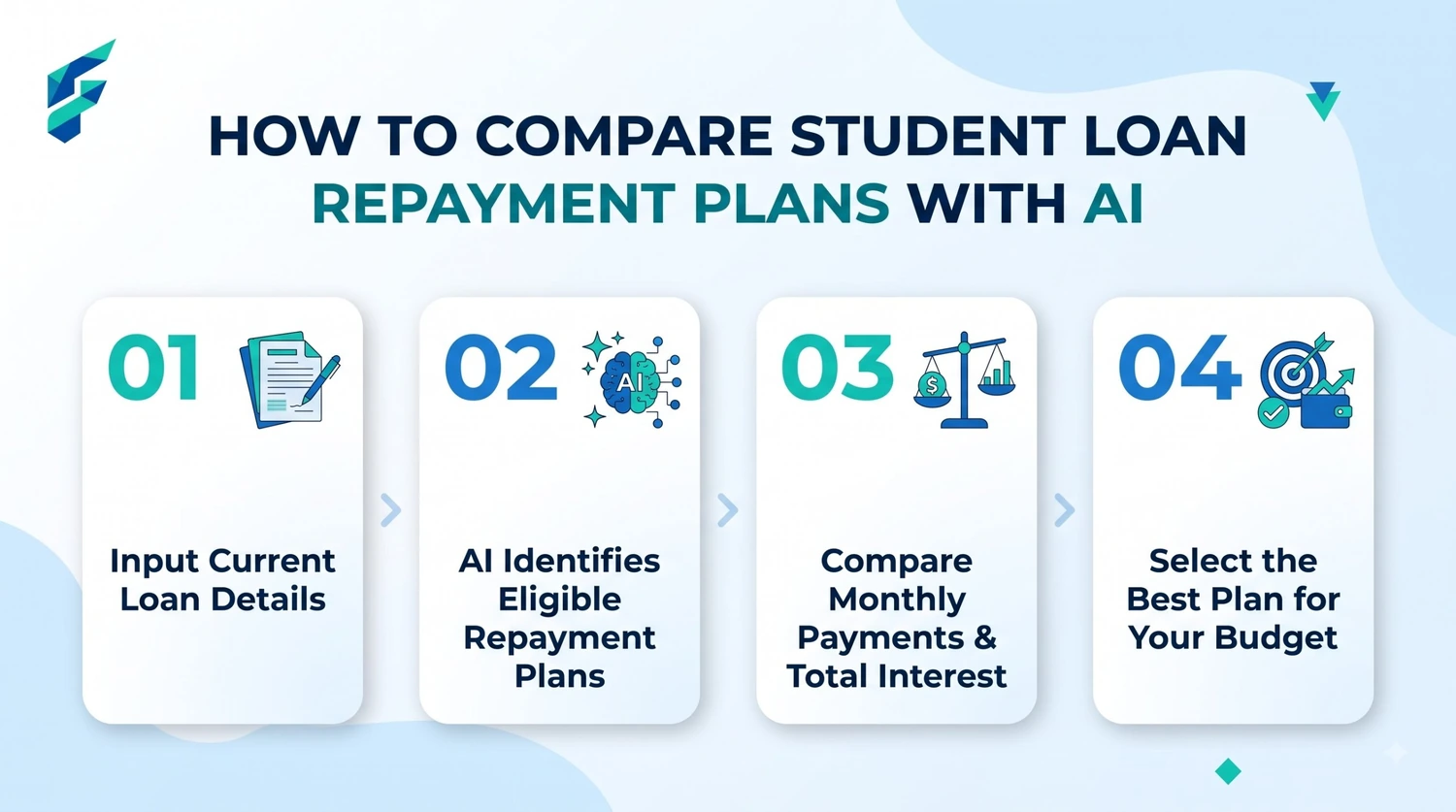
Choosing a repayment plan in late 2026 is harder than it was a year ago, because the menu changed. An AI tool can line the options up in one table, but it can only compare what you tell it is true. This guide shows you how to make that comparison, and which plan fits which person.
Which student loan repayment plan should you choose?
Choose the Tiered Standard plan if you can afford fixed payments and want the lowest total cost. Choose RAP if your income is low or unsteady and you want a payment that moves with it. Choose IBR if you only have older loans and want a 20 to 25 year path. Check your loan dates first.
What your loan dates decide
This is the part a chatbot can’t guess. Your options depend on when you borrowed or consolidated:
- Loans only from before July 1, 2026, with no consolidation after: you keep the older plans, plus RAP. ICR and PAYE are available until July 2028, then IBR is the only older income-driven plan.
- Any new loan or consolidation on or after July 1, 2026: only the Tiered Standard plan and RAP, covering all your loans, including older ones.
- Former SAVE borrowers: the plan is over, so you had to pick a new one after a 90-day notice.
Consolidating can also restart your forgiveness clock, so don’t consolidate just to get a lower payment without asking what you lose.
The plans side by side
| Plan | Payment based on | Term | Good for |
|---|---|---|---|
| Tiered Standard | Fixed amount; term depends on balance (shorter for smaller balances) | 10–25 years | Steady income, lowest cost |
| RAP | 1–10% of AGI, $10 minimum, $50 off per dependent | 30 years | Lower or uneven income |
| IBR | Share of discretionary income; can be $0 | 20 or 25 years | Older loans, lower income |
| ICR / PAYE | Share of income | Until July 2028 for eligible borrowers | Only if you already qualify |
| Older fixed plans | Fixed or stepped amount | 10–25 years | Pre-July 2026 borrowers |
I’m keeping the exact Tiered Standard terms light on purpose. They’re set by balance bands, so confirm yours on the StudentAid.gov plans page before relying on a number.
A $60,000 borrower, three ways
Say Sam owes $60,000 at a blended 6.0%. A fixed-term loan costs this much:
| Fixed term | Monthly payment | Total interest |
|---|---|---|
| 10 years | $666.12 | $19,935 |
| 20 years | $429.86 | $43,166 |
| 25 years | $386.58 | $55,974 |
Now RAP, which ignores the loan size and looks at income. At an AGI of $55,000 Sam falls in the 5% band: $2,750 a year, or about $229 a month. That’s less than the roughly $300 of monthly interest on the loan, so the balance wouldn’t fall on its own. RAP waives unpaid interest on on-time payments and adds a principal match of up to $50. At an AGI of $85,000, the 8% band, Sam pays about $567, which is more than the 20-year fixed payment.
So RAP is the cheap plan for Sam at $55,000, and the expensive one at $85,000. Same loan, same person, different salary. And the 30-year clock is long.
Make AI build the comparison
I will give you my loan facts and the plan rules. Compare the plans in a table.
Loans: $60,000, 6.0% blended, first borrowed 2023, no consolidation. AGI $55,000, single, no dependents.
Rules: [paste rules from StudentAid.gov for each plan].
Columns: monthly payment, term, total paid, whether forgiveness applies, and what could go wrong.
If a rule is missing, write NEEDS CHECKING instead of guessing.
Then verify at least the RAP row yourself. Look up the percentage for your band, divide by 12, subtract $50 per dependent. If you’re working toward Public Service Loan Forgiveness, ask about qualifying payments too, since forgiveness under RAP for PSLF still happens after 10 years of qualifying payments.
Don’t let AI choose for you. It can’t see your account, your tax return or your future job. Use it for the table, then run your real loans through the official calculator. For forgiveness decisions, talk to a nonprofit counselor.
Borrowing in India? These plans are US-only. If you hold an Indian loan, compare EMI against tenure instead: a longer tenure lowers the EMI but raises total interest, exactly as the fixed-term table above shows.
Common questions
Sources and next reads
The plan summary draws on the Congressional Research Service’s explainer on the Repayment Assistance Plan and Department of Education guidance. Pair this with how to calculate student loan payments with AI for the fixed-plan maths, and the tools roundup to pick your calculator. When you’ve chosen, build the repayment planner around it.