🔍 Market Research · AI Productivity · Small Business
AI Tool to Find Competitors for Small Business
(Safe Method)
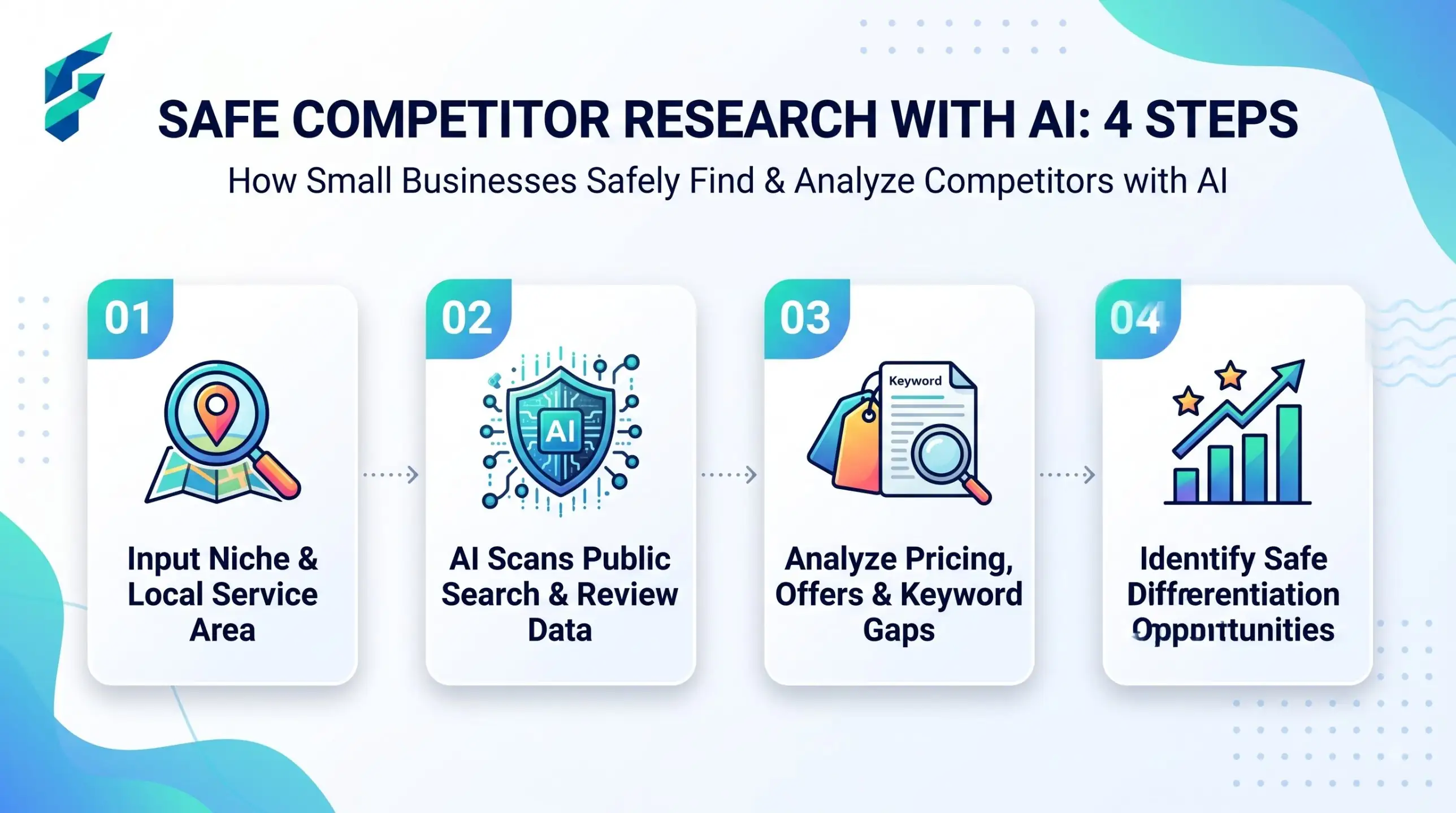
You can ask a chatbot "who are my competitors?" and get a clean list in seconds. The problem: some of the names may not exist. And the chatbot cannot see live prices or reviews. So use AI to organise what you find, not to find it.
Step one: find real competitors in three ways
1. Search like your customer.
Open a private browser window. Type what a customer would type, such as "tailor near me" or "cheap web design for shops". Write down the first 10 businesses you see, including the ads. These are the ones customers meet first.
2. Use map search.
Search your service on a map app. Check the businesses near your customers, not only near you. Open each profile and note what they show.
3. Ask people, then ask the AI.
Ask five customers: "Where else did you look before you chose us?" Their answers are gold. Then ask a chatbot for ideas you missed:
I run [type of business] in [city or area]. My customers are [who].
I sell [main product or service]. Suggest 10 types of businesses,
not names, that a customer might choose instead of me. Include
indirect options (for example a DIY kit or a bigger store).
Asking for types, not names, avoids invented companies. If the AI does give names, treat each one as a rumour until you check it.
Verify every name. Search it, find a real website or map profile, and confirm it is open and sells what you think. Delete any name you cannot find.
What AI cannot do here
- It cannot see today's prices, offers or stock.
- It cannot read live reviews unless you paste them.
- It may invent a competitor, or give an old one that closed.
- It does not know your neighbourhood.
Everything below works only because you bring the facts.
What to compare
Make a simple grid. Fill it by hand from public pages, then let AI tidy it.
| What to look at | What you write down |
|---|---|
| What they sell | Main products or services, and what they do not offer |
| Prices you can see | The price points shown publicly, and the date you saw them |
| Review themes | The 2 or 3 things people praise or complain about |
| Response speed | How long they take to answer a public question or comment |
| Photos | Are they clear, recent, real? |
| Location | Distance, parking, delivery area |
| Promises | Guarantees, free trials, delivery times |
The comparison-grid prompt
Paste only public information. Do not paste private messages or anything you got without permission.
Below are notes on 4 competitors of my business, from their public
websites and profiles, plus my own details. Today's date: [date].
Make a table with these columns: What they sell, Price points shown,
Review themes, Response speed, Photos, Location, Promises.
Use only the text I pasted. If something is missing, write "not given".
Then list 3 gaps: things customers want that none of the four do well.
For each gap, quote the line I pasted that supports it.
My business: [short description]
Competitor 1: [paste]
Competitor 2: [paste]
Real-world example: For my own freelance web design business, customers constantly tell me they love that I reply to messages within 2 hours. I checked my top 3 competitors' websites and none of them mention a specific response time guarantee. I added a "2-hour response guarantee" to my homepage, and it immediately became a key differentiator that won me new clients.
If the AI answers like this, do this
| What you see | What to do |
|---|---|
| A competitor name you cannot find online | Delete it. Ask again for "types, not names" |
| Prices that you did not paste | Say: "Remove any price I did not give you." |
| Praise for a competitor with no source | Ask: "Quote the pasted line, or remove it." |
| Gaps that are only obvious things | Ask for gaps backed by at least two pasted reviews |
| A table with guesses instead of "not given" | Repeat the "not given" rule |
Worked example (fictional)
A made-up bakery owner, Rosa, searches "birthday cake near me" and finds six bakeries. She checks each one, drops two that closed, and pastes notes on the other four. The AI table shows that three of them take orders only by phone. Review text she pasted mentions "hard to reach" twice. Her gap: easy ordering. Her action: add a WhatsApp order message to her profile. To write it, she uses our guide on AI tools to write WhatsApp Business messages. Rosa and her numbers here are an example, not a real business.
What to copy and what not to
Copy ideas that fix a customer problem. Do not copy their words or pictures.
- Copy: a service people clearly like, a clear price format, a useful answer to a common question.
- Copy the idea, not the words: a guarantee, a delivery promise, a layout.
- Do not copy: their text, photos, logo, name or style so close that customers confuse you.
- Do not match: a price war you cannot afford. Compete on what you do better.
- Do not chase: every feature. Pick the one that your own customers ask for.
A 20-minute check, once a month
- Search your three main phrases again (5 minutes). Note any new business.
- Open your top 3 competitors and note changes in price, photos, offers (8 minutes).
- Read their newest reviews and note themes (4 minutes).
- Paste your notes into the comparison prompt and ask only "What changed since last time?" (3 minutes).
Save the grid in one file with the date. After three months you can see trends.
Ethics and limits
- Use only public information.
- Do not create fake accounts, pose as a customer to get private details, or ask staff for secrets.
- Do not post fake reviews, good or bad.
- Do not copy their text, images or logo. That can cause legal trouble, and customers notice.
- If you pasted a private message by mistake, remove it and start again.
Rules differ by country, so check yours if you are unsure.
Turn gaps into one action
A list of 10 gaps does nothing. Pick one:
- Choose the gap that customers mention most.
- Pick the smallest change that fixes it this month.
- Write how you will know it worked, for example "5 more orders by WhatsApp".
- Check again next month.
Ideas for what to do next are in our guides to AI tools to boost sales for small business and practical AI use cases for small business. If you want to write about your difference on your site, see how to write an About Us page.
When NOT to use AI for this:
• When you have not looked at a single competitor page yourself. The AI will guess.
• When you need current prices. Open the page and read it.
• When the information is private or came from a leak.
• When you only want to copy someone. Find your own reason to exist first.
Common questions