🤝 Student Loans · Hardship · AI Help
AI Help for People Struggling With Student Loan Payments
(What to Do Before You Miss One)
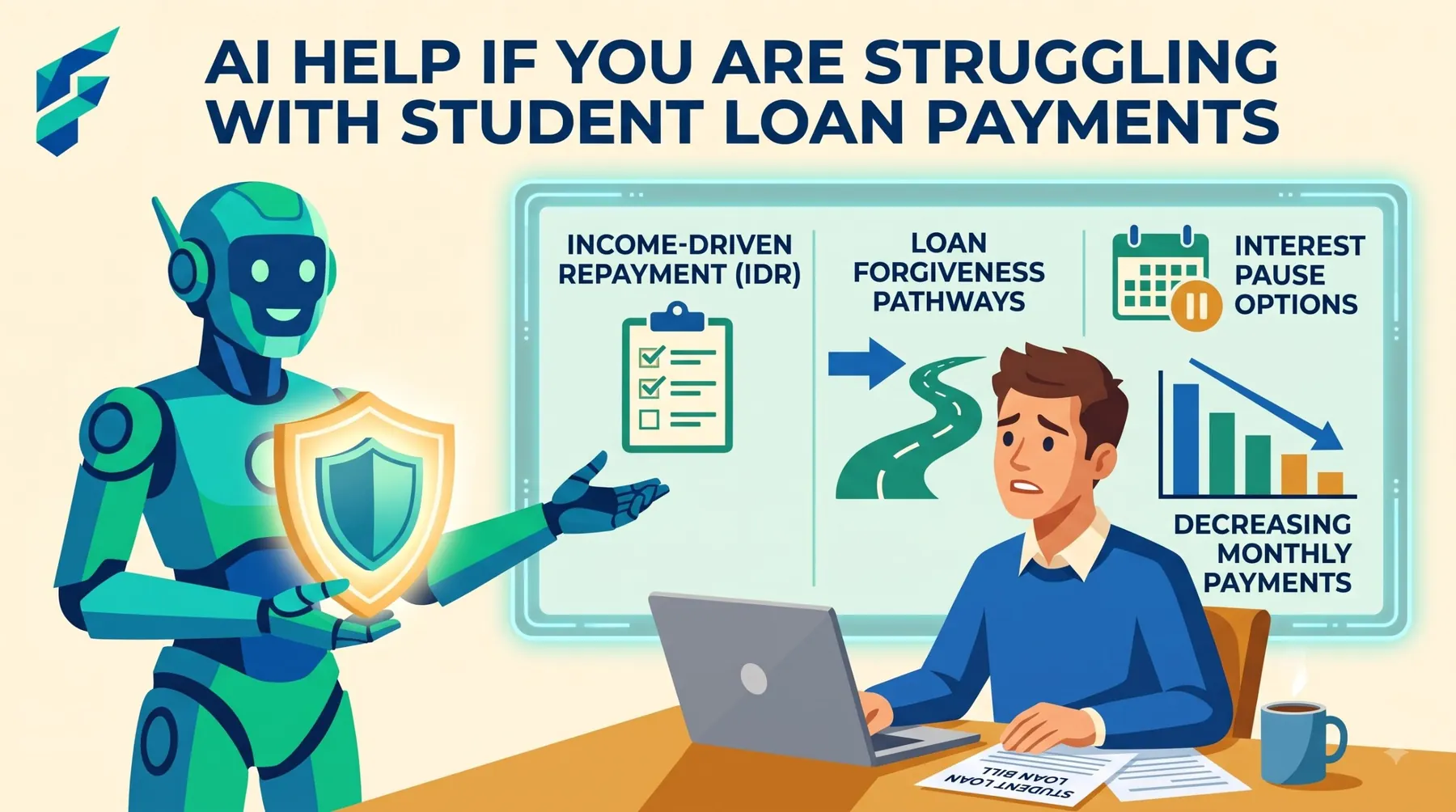
If you’re reading this because the payments feel impossible, you’re in a very large group, and there are real options. The most important one is also the simplest: contact your servicer before you miss a payment. This guide is about using AI to get ready for that call, and to understand what you’re being offered.
What should you do if you are struggling with student loan payments?
Call your servicer before the due date, explain that you can’t afford the current payment, and ask what options exist for your loan type. Ask about income-based plans first, and temporary pauses second. Use AI to organise your numbers and rehearse the call, not to decide for you.
Know where you stand
Federal loans become delinquent the day after a missed payment. They enter default after about 270 days of missed payments, according to Federal Student Aid guidance. The earlier you act, the more options you keep.
| Status | What it means | Your move |
|---|---|---|
| Current but strained | You’re paying, but barely | Ask for an income-based plan; rework the budget |
| Delinquent | One or more payments missed | Call now; ask to catch up or change plans |
| Default | Roughly 270+ days missed | Ask about rehabilitation or consolidation |
| Private loan trouble | Lender’s rules apply | Ask the lender for hardship options in writing |
The options, in plain terms
- An income-based plan. Your payment follows your income, and can be very low if your income is low. This usually beats pausing. See how to compare the plans with AI.
- Deferment or forbearance. A temporary pause. Check the cost first. On a $20,000 loan at 6.39%, a year of unpaid interest is about $1,278 if it keeps accruing. Some loans don’t accrue interest in deferment, so ask.
- Rehabilitation (for defaulted loans). Several months of agreed payments (often nine) bring the loan out of default. Borrowers can rehabilitate a second time from July 1, 2027.
- Consolidation. Combines loans into one and can also get a loan out of default, with trade-offs. Ask before choosing it.
Collections on defaulted federal loans, including wage garnishment and tax refund offsets, were paused in January 2026. I haven’t seen a restart date, but that can change, so check the Default page on StudentAid.gov for the current position.
Step 1: Get your numbers out of your head
I am struggling to pay my student loans. Help me organise this.
Monthly take-home: $[X]. Essentials (rent, food, transport, utilities, insurance): $[X].
Loans: [balance, rate, type, servicer for each]. Current payment: $[X]. Status: [current / behind by X months].
1) Show how much I can really pay. 2) List the questions I should ask my servicer.
3) Tell me which of my numbers you are unsure about.
Step 2: Rehearse the call
Ask the AI to play the servicer so you can practise saying the hard sentence aloud: “I can’t afford my current payment and want to know my options.” Then write down the name of the person, the date, and what they offered. Ask for anything important in writing or by secure message.
Step 3: Draft a hardship letter, then check it yourself
Draft a short, polite hardship message to my loan servicer.
Facts: my income dropped from $[X] to $[X] on [date]. My essential costs are $[X].
Ask what income-based or hardship options exist for my loan type. Keep it under 150 words.
Read it, remove anything untrue, and send it from your own account. Leave out account numbers and your FSA ID.
Be careful of anyone who offers a shortcut
When you’re stressed, offers like “get your loans erased for a fee” sound good. Federal plans and consolidation are free to apply for on StudentAid.gov. If a service wants money up front, walk away. If something has already gone wrong, the Federal Student Aid Ombudsman can help with disputes.
One more thing: debt stress is heavy, and it’s easier to avoid opening the letters. Doing one small step, like logging in to StudentAid.gov or writing your numbers down, counts. If it’s weighing on you, tell someone you trust, or a counselor.
Don’t rely on AI to: promise what a servicer will approve, interpret a legal notice, or advise on bankruptcy. Those need a person: your servicer, a nonprofit counselor, or a lawyer.
Borrowing in India? Talk to your bank’s branch manager early. Many banks can restructure the repayment schedule if you ask before you default. Get any agreement in writing.
Common questions
Related
When the budget is the problem, work through the student loan budget planner. If you’re also looking for forgiveness options, read how to check forgiveness eligibility online. For how interest keeps building on a pause, see the AI student loan interest calculator guide. And if income is the root issue, the graduate toolkit covers job-search tools.