👪 Student Loans · Parent PLUS · AI Calculators
AI Parent PLUS Loan Repayment Calculator
(New Limits, Real Costs)
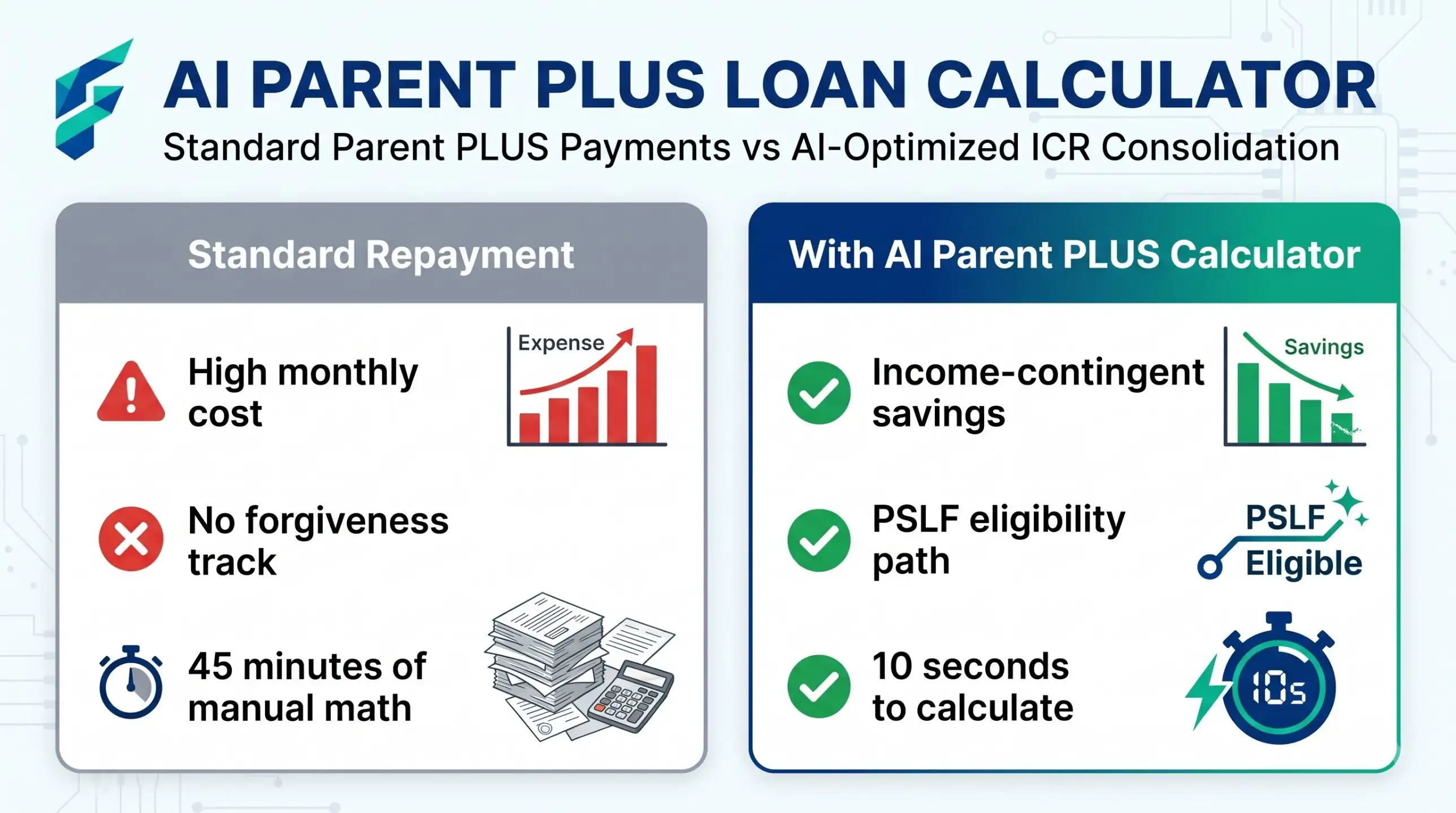
Parent PLUS loans are the loans that parents take out for a dependent student. They’re also the most expensive federal loans and have the fewest repayment options, so the maths matters more here than anywhere else. An AI calculator can show a family what the loan really costs before they sign.
How do you calculate Parent PLUS loan repayment?
Use the standard payment formula with the loan balance, the PLUS interest rate (currently around 9%, so confirm the exact figure) and a repayment term. Ask AI to show the payment and total interest. Remember that interest starts at the first disbursement, and an origination fee is taken out of each one.
The new limits
For new Parent PLUS borrowing from July 1, 2026, the cap is $20,000 per dependent student per year and $65,000 in total per student. Families who borrow the maximum each year can reach the cap in about the fourth year. Some parents who already borrowed for the same student before July 1, 2026 have transition rules, so check yours on StudentAid.gov. Grad PLUS has ended for new borrowers, which is why more families are asking what to do about the gap.
What a $60,000 Parent PLUS balance looks like
Say parents borrow $20,000 a year for three years, reaching $60,000 at about 9%. The 10-year standard payment would be $760.05 a month, with $31,207 of total interest. Stretch it to 20 years and the payment falls to $539.84, but total interest climbs to $69,561, more than the loan itself.
| Term | Monthly payment | Total interest |
|---|---|---|
| 10 years | $760.05 | $31,207 |
| 20 years | $539.84 | $69,561 |
Interest also builds before the first payment. On a $20,000 disbursement at 9%, that’s about $1,800 a year while the student is in school. Parents who can pay the interest during school keep the balance from growing. If the interest is paid as it builds, the table above is the balance you start repaying from.
The repayment options are narrower
Parent PLUS loans aren’t eligible for the new Repayment Assistance Plan. Older Parent PLUS loans that were consolidated may reach an income-driven plan, but there is a deadline of July 1, 2028 for enrolling in a qualifying plan to keep that path. The rules are detailed, so use the StudentAid.gov Parent PLUS page before you decide. That narrow menu is why calculators for this loan should always include a worst-case payment, not only the best case.
Parent PLUS repayment calculator. Parent income: $[X]. Loan: $60,000 at 9% (check current rate).
Calculate the payment for 10 and 20 years, total interest, and what share of my monthly take-home it is.
Also calculate interest that builds during 4 years of school on 3 disbursements of $20,000.
Show formulas. If any fee or rule is unknown, say so.
Options that can lower the bill
- Borrow less. Compare the cost of an alternative: an in-state school or a smaller loan.
- Pay interest during school. Even small amounts reduce the balance that grows.
- Decide in advance who pays. If the student will repay, discuss it before borrowing. Legally, the parent owes the loan.
- Look at the student’s own limits first. See the borrowing calculator guide for how much a student can borrow in their own name.
Careful: a student can’t transfer a Parent PLUS loan into their own name without refinancing it privately, and doing that ends federal protections. Don’t put parents’ SSN or account numbers into a chatbot, and don’t pay anyone to “fix” the loan.
Borrowing in India? Indian parents who co-sign an education loan are jointly responsible. Ask the bank in writing what happens to the co-borrower’s obligation if the student cannot pay.
Common questions
Related
To check a family’s budget against the payment, use the student loan budget planner. To compare payment lengths, see the payment formula guide, and for free guidance, check the CFPB’s student loan tools.