🎯 Student Loans · Borrowing · AI Calculators
AI Student Loan Borrowing Calculator
(How Much Can You Safely Borrow?)
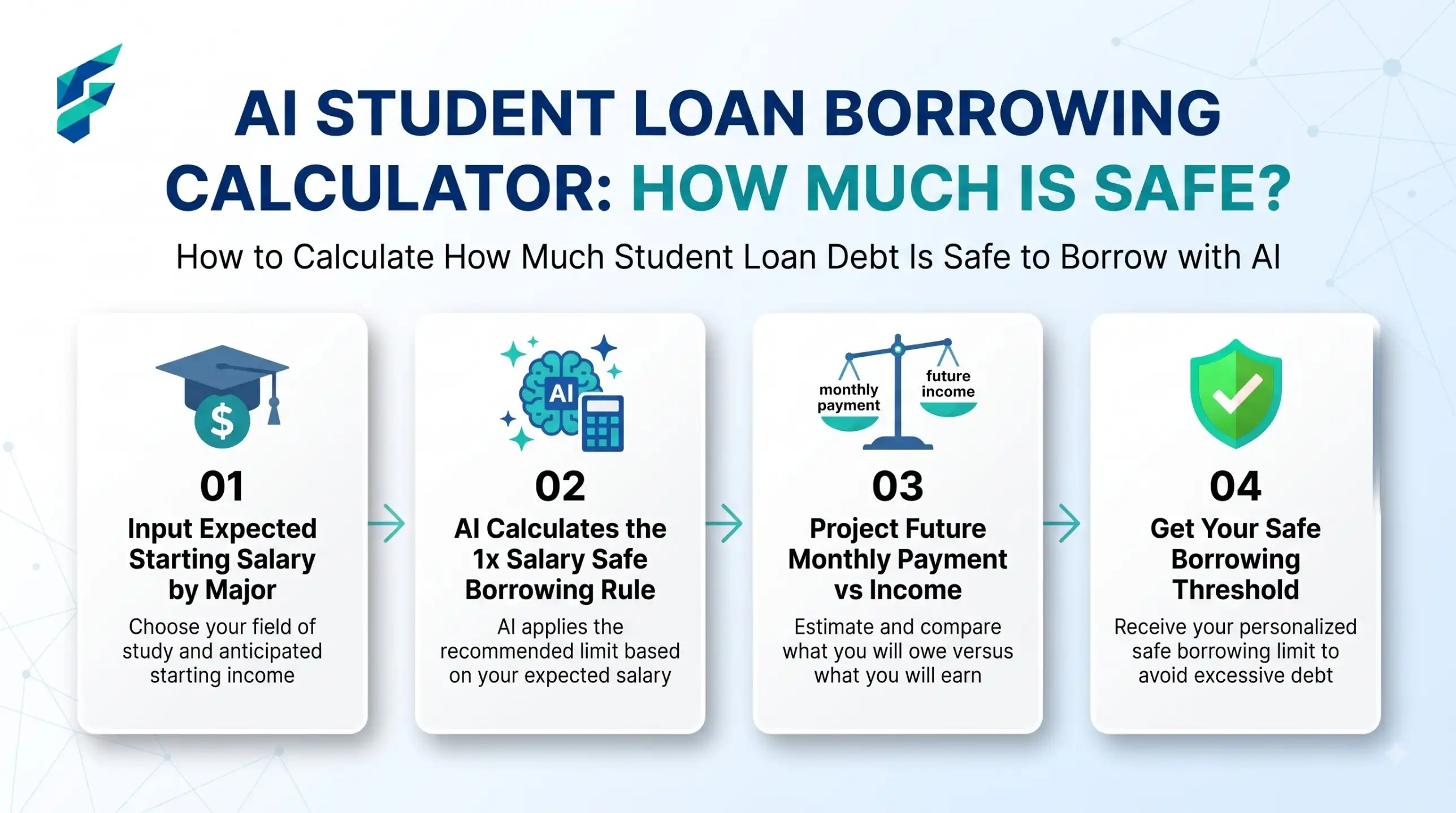
The best time to run a student loan calculator is before you borrow. Once the money is spent, the payment is fixed. An AI borrowing calculator turns “how much can I borrow?” into the better question: “how much can I afford to repay?”
How much student loan can you safely borrow?
A common rule of thumb is to keep your total student debt below your expected first-year salary. Better still, check that the 10-year payment stays near 10% of gross monthly pay. Use AI to calculate that payment at several loan sizes before you accept an aid offer.
See it at one salary
Suppose you expect a starting salary of $48,000, which is $4,000 a month before tax. At 6.52% on a 10-year plan:
| Total borrowed | Monthly payment | Share of gross pay | Total interest |
|---|---|---|---|
| $24,000 | $272.76 | 6.8% | $8,731 |
| $36,000 | $409.14 | 10.2% | $13,097 |
| $48,000 | $545.52 | 13.6% | $17,462 |
| $60,000 | $681.90 | 17.0% | $21,828 |
The pattern is clear. At $36,000 the payment is about a tenth of gross pay. At $60,000 it’s closer to a sixth, which leaves little room after rent, food and tax. That’s why the cap, borrowing no more than your first-year salary, is a limit, not a goal. Many people borrow less than the limit when they run this table.
Borrowing calculator. Expected starting salary: $[X] a year.
Loan rate 6.52%, 10-year repayment.
For total debt of $20,000, $30,000, $40,000 and $50,000, calculate the monthly payment,
the payment as a percentage of gross monthly pay, and total interest.
Flag any option above 10% of gross pay.
Get the salary figure from a real source, not hope: your school’s graduate outcomes data, a job listing, or a similar role. If your field pays less, run the numbers at the low end.
Know the federal limits
The new limits for loans from July 1, 2026 are important for graduate students:
| Borrower | Annual limit | Lifetime limit |
|---|---|---|
| Graduate student (unsubsidised) | $20,500 | $100,000 |
| Professional student | $50,000 | $200,000 |
| Parent PLUS (per student) | $20,000 | $65,000 |
| All federal loans combined | — | $257,500 |
Graduate PLUS loans have ended for new borrowers, and undergraduate limits are unchanged. Programs that count as “professional” are defined by federal rules, so ask your school which category you’re in. The new caps mean more students will need to cover a gap. Our Parent PLUS guide covers the parent side.
What to do if the gap is large
- Ask the school for a lower-cost path: a shorter program, cheaper housing, or in-state rates.
- Look for scholarships, assistantships and employer tuition benefits first.
- Compare private loans only after federal ones, on rate, fees, cosigner terms and hardship options.
- Remember that private loans don’t offer income-based plans or forgiveness. The plan comparison guide shows what federal borrowers get.
Rates to use
Federal rates reset each year. The current figures are in the Department of Education’s 2026–27 rate announcement. Use the rate for your loan type, not a general figure.
Limits of this method: a salary estimate is a guess, and AI can’t verify it. It also doesn’t include interest that builds while you study on unsubsidised loans, so add that to the totals. Don’t treat the maximum offered as the amount you need.
Borrowing in India? Compare the total repayable amount, not only the EMI, across banks. Ask about collateral, the moratorium length and any processing fees, then test two or three loan sizes against your expected starting salary.
Common questions
Next
After you borrow, use the repayment calculator guide to track the payment and the after-graduation guide for the first year. A stronger starting salary helps at both ends, so see the fresher resume guide.