🏦 Student Loans · Private vs Federal · AI Calculators
AI Private vs Federal Student Loan Calculator
(Rates, Fees and What You Give Up)
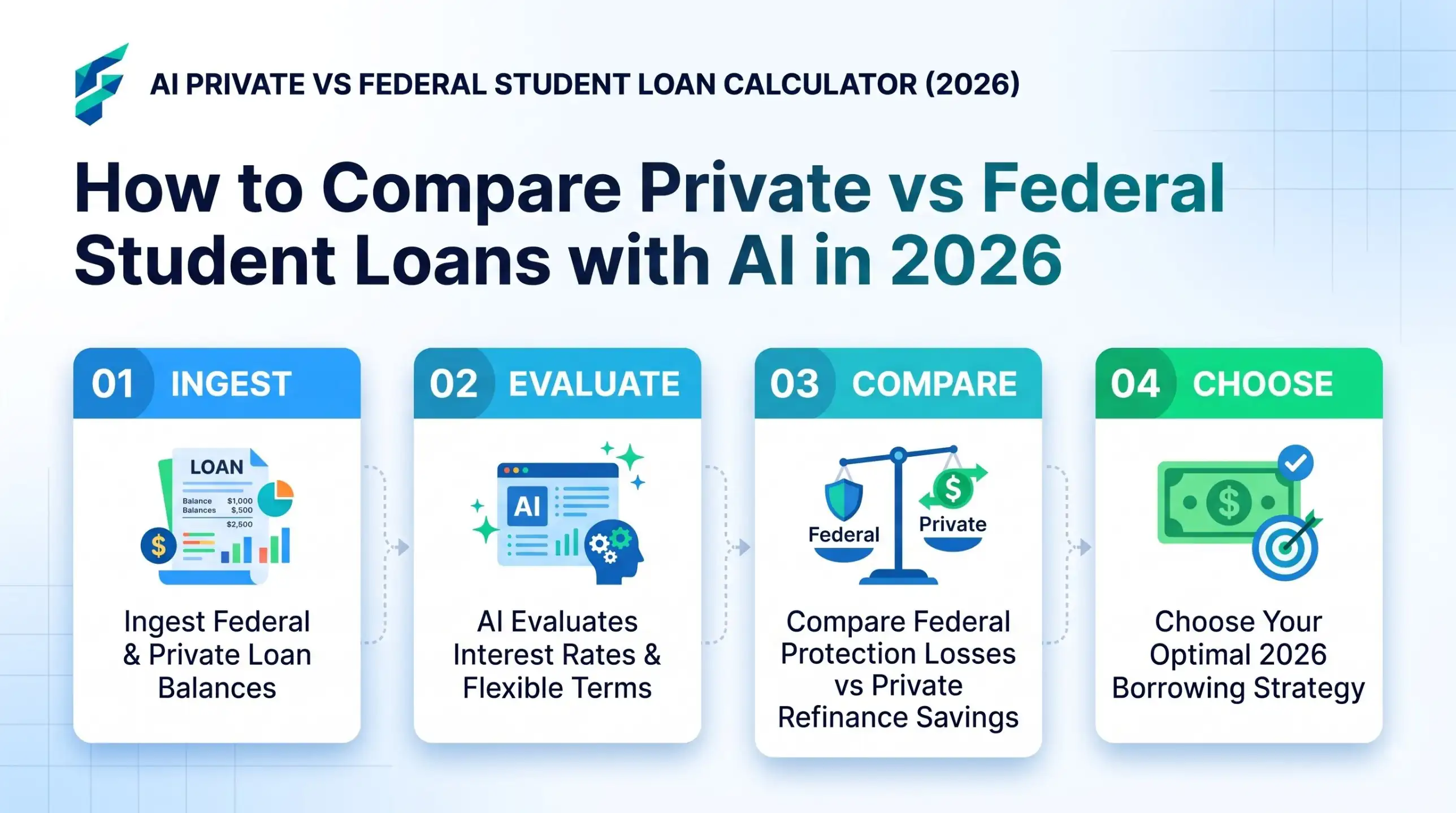
The headline rate is rarely the whole story when you compare private and federal student loans. A private offer can look cheaper on the first page and cost more by the last. An AI calculator helps you put them on the same page: the payment, the total interest, and the safety net you do or don’t get.
Is a private or federal student loan better?
For most borrowers, federal loans come first: fixed rates, no credit check for most undergraduate loans, and protections like income-based plans. Private loans can make sense after federal limits are used up, or for a borrower with strong credit who can get a clearly lower fixed rate and doesn’t need federal protections.
What you get with each
| Feature | Federal | Private |
|---|---|---|
| Rate | Fixed for the life of the loan | Fixed or variable, set by your credit |
| Credit check | Not for most undergraduate loans | Yes, usually with a cosigner for students |
| Income-based repayment | Yes (RAP and others, depending on dates) | Rarely |
| Forgiveness programs | PSLF, IBR/RAP forgiveness, teacher programs | Usually none |
| Pause options | Deferment and forbearance with rules | Lender decides; often short |
| Cosigner | Not needed for most | Often needed; can be released only in some cases |
| Fees | Origination fee of about 1% on most loans | Varies; some have none |
Same $30,000, five different loans
Take a 10-year loan of $30,000. The federal figure uses the 2026–27 undergraduate rate of 6.52%. The private offers are made up, but typical of the spread you see between good-credit and weak-credit borrowers.
| Loan | Rate | Monthly payment | Total interest |
|---|---|---|---|
| Private, strong credit or cosigner | 4.9% fixed | $316.73 | $8,008 |
| Federal undergraduate | 6.52% fixed | $340.95 | $10,914 |
| Private, average credit | 8.0% fixed | $363.98 | $13,678 |
| Private, weak credit | 10.5% fixed | $404.80 | $18,577 |
A private loan can beat the federal one by about $2,900 of interest if your credit is strong. For an average or weak profile it costs thousands more. Federal loans also carry an origination fee of about 1% (about $317 on $30,000), so use the net amount you receive when you compare.
The variable-rate trap
A low starting rate looks great. Say a variable loan starts at 5.5% for two years, then resets to 9%. The payment starts at $325.58, then jumps to about $369.77, and total interest comes to about $13,312, more than the $10,914 federal loan and more than the 8% fixed one.
| Loan | Starting payment | Later payment | Total interest |
|---|---|---|---|
| Federal, 6.52% fixed | $340.95 | $340.95 | $10,914 |
| Private variable, 5.5% then 9% | $325.58 | about $369.77 | about $13,312 |
Ask any lender for the maximum rate and the schedule of changes before you sign. If the answer is vague, that is a signal.
Compare these loans for $30,000 over 10 years.
Federal: 6.52% fixed. Private A: 4.9% fixed. Private B: 8% fixed. Private C: variable, 5.5% for 2 years, then 9%.
For each: monthly payment, total interest and the maximum payment.
Then list the protections each one offers or does not offer. Use only the facts I gave you.
Questions to ask a private lender
| Question | Why it matters |
|---|---|
| Is the rate fixed or variable? What is the cap? | Decides your worst-case payment |
| Is there any fee, and is interest charged during school? | Changes the true amount you owe |
| What happens if I lose my job? Is there a hardship option? | The safety net is often thin |
| Can my cosigner be released, and when? | Protects the cosigner’s credit |
| What happens to the loan if I die or become disabled? | Rules differ widely for private loans |
| Can I check my rate with a soft credit check? | Lets you compare without credit damage |
When private loans make sense
- You’ve used your federal loan limits and still have a gap. See our borrowing calculator guide.
- Your credit or your cosigner’s credit is strong enough for a clearly lower fixed rate.
- Your income is stable and you won’t need income-based repayment or forgiveness.
- You’ve compared at least three lenders, with the maximum rate and fees in writing.
If you already hold federal loans and are thinking of swapping them for a private one, that’s refinancing, covered in the refinance guide. Don’t do that without reading it.
Be careful: a cosigner is fully responsible for the loan, and a missed payment hurts their credit. A chatbot can compare numbers but can’t read your contract. Read the promissory note, and never share account numbers or SSNs in a chat.
Borrowing in India? Compare a bank education loan with an NBFC loan on the final rate after fees, whether interest is simple or compounded during the moratorium, and the collateral demanded. Choose by total repayable amount.
Common questions
Next steps
After you choose, track the loan with the tracker spreadsheet guide. For the federal plan menu, see the plan comparison guide. For rates, use the Department of Education’s 2026–27 rate announcement.